
Choosing a dryer for a cosmetic intermediate starts with the formulation, not the chamber volume. By defining the product’s moisture, solvent, heat sensitivity, loading behaviour, cleaning needs and safety risks, you can compare equipment specifications and write an acceptance test that proves the dryer will perform on your batches.
Key takeaways
- Match tray drying conditions to moisture, solvent, viscosity and stickiness risks.
- Validate temperature, vacuum, drying time and final moisture as one cycle.
- Size the chamber by usable tray area, not gross internal volume.
- Specify solvent recovery, vacuum protection, hygienic design and acceptance tests.
Match the dryer to the cosmetic formulation and its failure risks
Dryer selection starts with the formulation’s failure risks, not its batch mass. In cosmetic manufacturing, record initial moisture, target final moisture, solvent type, viscosity, stickiness, particle size and bulk density before choosing chamber volume, tray area or vacuum capability.
| Formulation | Properties and risks to record | Initial specification consequence |
|---|---|---|
| Creams, ointments, waxes and pastes | High viscosity, stickiness, deep-bed crusting, trapped moisture | Specify a shallow maximum wet-bed depth, controlled loading method and adequate shelf heat transfer |
| Botanical extracts and fragrance-bearing concentrates | Oxidation risk, solvent retention, fragrance retention, heat sensitivity | Require controlled vacuum, condenser capacity and an endpoint based on final moisture or residual solvent |
| Pigments and colour-sensitive slurries | Colour sensitivity, agglomeration, difficult cleaning | Prioritise uniform product temperature, gentle handling and cleanable product-contact geometry |
| Powders and granules | Particle size, bulk density, dusting, segregation and variable initial moisture | Specify tray loading limits, containment and sampling locations across the bed |
A dryer that dries quickly but leaves a crust, colour shift or fragrance loss is a failed selection. Define accessible welds, drainable geometry, compatible elastomers and a surface-finish requirement for every product-contact area; stainless-steel grade alone does not prove cleanability.
For low-dose actives, pigments and botanical extracts, cross-contamination control can outweigh drying capacity, so include cleaning verification and changeover requirements in the initial specification.
Set vacuum and temperature as a validated drying cycle
Select operating pressure from the formulation’s measured boiling behaviour, not from a target labelled “vacuum.” At a stated pressure in mbar absolute, determine the boiling point of the actual solvent mixture; dissolved solids and concentration shift it, and the water boiling point falls only as pressure falls.
A deep vacuum that supports fragrance retention in one slurry can still overheat a concentrated cream, while an aggressive pressure drop can cause foaming and bumping.
Define the cycle in a controlled recipe:
- Record the loading temperature and wet-bed depth for every batch.
- Set the shelf-fluid temperature, then verify the product temperature at representative tray positions.
- Specify the vacuum ramp so trapped air and volatile components leave without sudden boiling.
- Set the hold time only after the product reaches the intended pressure and temperature.
- Define the endpoint temperature and endpoint moisture, with residual-solvent limits where applicable.
- Specify condenser duty and the cooldown temperature before venting.
Validate the recipe under representative load, not in an empty chamber. Map shelf-fluid temperature at the selected pressure, measure product temperature on upper, middle and lower trays, and perform a vacuum-hold or leak test. Test samples from different tray positions for endpoint moisture and residual solvent; otherwise a dry surface can conceal wet material below.
Record the full pressure, temperature and time profile so operators can reproduce the cycle and investigate deviations.
Size the chamber around usable tray loading and hygienic construction
Calculate usable capacity from tray loading, not nominal chamber volume. Multiply the usable tray area by the number of trays, then confirm the result using the permitted fill mass per tray: usable capacity = number of trays × fill mass per tray.
Set that mass for the maximum wet-bed depth, because a thick layer can form a dry crust while moisture remains trapped underneath.
- Define usable tray area after allowing for tray edges, shelf clearances and airflow paths.
- Record fill mass per tray at minimum, nominal and maximum loads to capture load variability.
- Specify the maximum wet-bed depth for each product family, especially creams, waxes and pastes.
- Confirm shelf contact and temperature uniformity at the intended loading depth; chamber volume alone will not predict drying time.
Use 316L stainless steel for product-contact surfaces, including trays, shelves and internal fittings, then state the surface finish rather than accepting “polished” as a specification. A common requirement is an Ra of 0.8 µm or finer, subject to the formulation and cleaning method.
Require continuous, smooth welds with documented weld quality, no cracks, undercut or crevices.
Specify radiused corners, accessible welds, chamber drainage and full drainability toward the outlet. Use compatible door seals and inspect their grooves for retained residue. Removable trays support inspection and cleaning; fixed supports can obstruct access and weaken cross-contamination control when fragrances, pigments or low-dose actives change between batches.
Design solvent containment, vacuum protection and hazardous-area controls
Treat flammable solvents as an explosion-risk service from the design stage. A vacuum dryer is not intrinsically explosion-proof because its pressure is below atmosphere; air can enter through leaks, seals or venting. Define the following before selecting equipment:
- Solvent flash point and boiling range
- Peak vapor concentration and oxygen-ingress scenarios
- Hazardous-area classification for the dryer, instruments and electrical devices
- Required grounding and bonding points
- Pressure relief capacity and discharge location
- Whether inert-gas operation is required
For equipment placed on the European market, check ATEX Directive 2014/34/EU for equipment intended for potentially explosive atmospheres. Separately, use Directive 1999/92/EC to address workplace zone classification and operator protection. These obligations do not replace pressure-vessel or machinery requirements.
Size condenser duty for the peak vapor load, not average evaporation. Add a knock-out pot upstream of the vacuum pump and monitor condenser temperature; solvent reaching the pump can dilute oil, attack elastomers, reduce vacuum-pump protection and contaminate the exhaust. Specify solvent recovery if recovered liquid has production or disposal value.
A demister or entrainment separator limits foaming and bumping carryover during rapid vacuum reduction.
Use a controlled nitrogen purge for startup, shutdown and venting where the hazard assessment requires it. Provide interlocks for low condenser temperature, high pressure, loss of inert gas and abnormal oxygen level, plus pressure relief sized for credible blocked-outlet and runaway-vapor cases.
Turn the selection into a supplier specification and acceptance test
Put the acceptance criteria in the purchase specification before comparing quotations. ISO 22716 supports documented cleaning, calibration, maintenance and contamination controls; it does not select your pressure, temperature or endpoint.
- Require the general arrangement, product-contact material certificates, weld and surface-finish records, instrument list, control philosophy, cleaning procedure, calibration records and maintenance documentation.
- Require a factory acceptance test covering shelf-temperature mapping at representative mbar absolute conditions, product-temperature mapping at multiple tray positions, and a vacuum-hold test plus leak-rate test.
- Define samples from top, middle and bottom trays for moisture, colour, fragrance retention and residual solvent. Set each limit before ordering, using ICH Q3C(R8) as a technical benchmark where appropriate; do not assume its limits automatically govern a cosmetic.
- Require a written cycle recipe with vacuum-ramp limits, shelf-fluid temperature, condenser duty, cooldown, venting method and nitrogen purge sequence where oxidation or flammable solvent risk demands it.
- Require endpoint repeatability across at least three agreed runs, with the same loading mass, tray arrangement and starting condition.
Nes India Engineers should state which tests it performs at its works, which require your product, and which results appear in the final dossier. Reject a dryer that passes an empty-chamber temperature check but cannot show product-temperature and residual-solvent results. Record deviations, corrective actions and re-test limits in the site acceptance test.
Related product
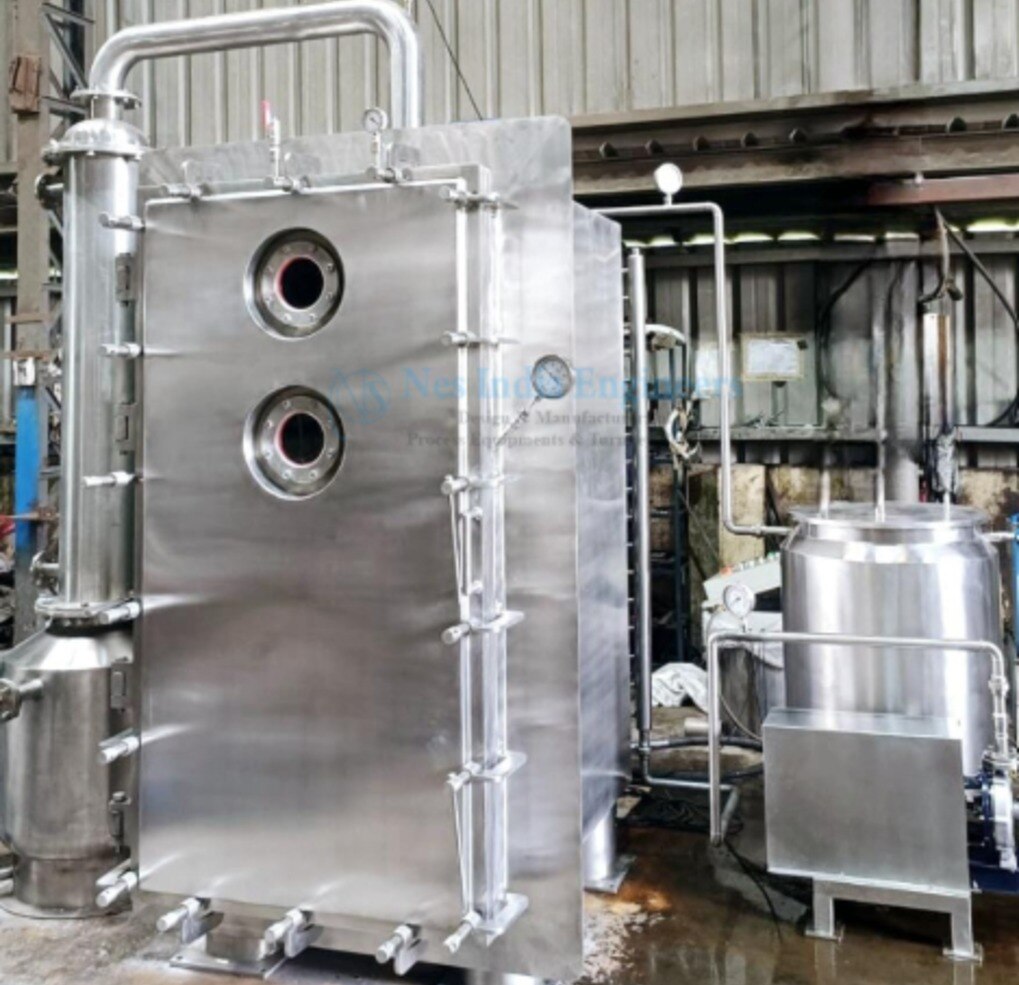
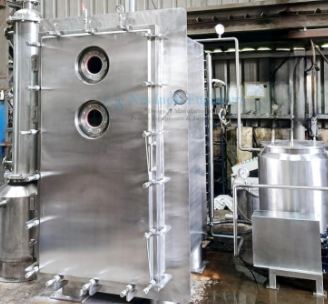 | Batch Dryers We Ness India Engineers from Pune, Maharshtra, India are a leading manufacturer, supplier and exporter of vacuum tray dryer in India. View product → |