
Atmospheric batch drying depends on more than heating a cabinet: feed form, bed depth, airflow, exhaust conditions and the moisture end point all determine whether a batch dries evenly. By the end, you will know how to define the process, inspect the dryer design, avoid common defects and judge whether a supplier can support safe, repeatable production.
Key takeaways
- Spread material evenly and record tray load, thickness, temperature and airflow.
- Match dryer capacity to wet mass, moisture content, solids form and target endpoint.
- Specify stainless-steel construction, cleanable surfaces, seals and airflow distribution.
- Compare suppliers using test data, drawings, controls, documentation and service support.
How does atmospheric batch drying work from loading to unloading?
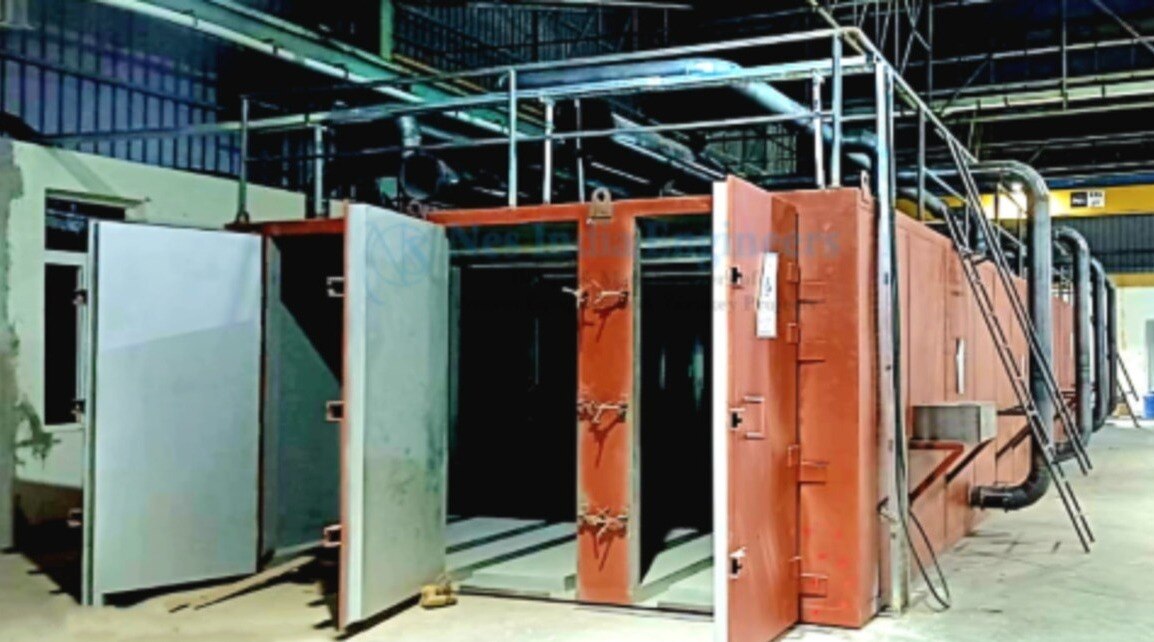
An operator spreads wet cake, granules, crystals, powder or paste across trays, loads the shelves, and closes the chamber. Heated air passes across the loaded shelves; a defined portion recirculates while moisture-laden air leaves through the exhaust.
1. Specify the air path before purchase. State inlet temperature, exhaust temperature, airflow pattern, fresh-air and recirculation fractions, tray loading, target product temperature and acceptable residual-moisture range—not only the heater temperature.
2. Run the batch against a measurable end point. Monitor inlet and exhaust temperatures, product temperature and airflow; sample defined tray locations and test loss on drying, residual solvent, water activity or another approved attribute. Unload only after the result reaches specification, not when a fixed timer expires.
3. Keep the pressure boundary clear. Atmospheric drying cannot provide vacuum’s lower boiling temperature or oxygen-reduced environment. Choose vacuum for heat-sensitive materials, inert gas for oxidation-sensitive products, and dehumidified air when the material must dry below the available hot-air dew point.
4. Treat solvent service as a design review, not a standard option for an atmospheric tray dryer in Pune. Ask how the system controls solvent-vapour concentration, ventilation, ignition sources, electrical classification, bonding, grounding and exhaust disposal. Confirm those controls before selecting the dryer.
How do you match the feed and batch recipe to the dryer?
Match the feed form and recipe to the resistance the wet bed creates, not to the dryer’s empty-chamber airflow. A thin, evenly spread layer dries differently from a thick filter cake, even at the same batch mass.
1. Identify the feed: wet cake, filter cake, granules, crystals, powder or paste. Record moisture content, particle-size distribution, filter-cake thickness, tendency to crust or agglomerate, fill weight and solvent content.
2. Define the loading geometry. Specify tray material, tray dimensions, spacing, exposed surface area and permitted bed depth. A deeper bed increases airflow resistance and can leave a wet centre; a smaller particle size can pack tightly and slow vapour escape. Excessive fill weight has the same effect.
3. Run representative product trials at proposed bed depth and loading. Set product temperature, air velocity, batch size and residence time from moisture results and product quality, not from empty-chamber airflow or a fixed timer.
Excessive temperature can discolor or degrade the product; excessive velocity can erode powders, create channeling or dry the surface into a crust.
4. Test scale-up before adding trays or tray area. More area does not guarantee proportional throughput: check fan capacity, pressure drop, airflow resistance and exposed surface-to-bed-volume ratio.
5. Require the quotation for batch drying equipment in Pune to state wet-basis and dry-basis capacity, tray dimensions, tray count, permitted bed depth, airflow and guaranteed drying performance for the proposed batch. Include the trial end point and acceptance moisture range.
Which dryer construction details control uniformity and contamination?
| Feature | Uniformity or contamination risk | Design control |
|---|---|---|
| Tray geometry and shelf spacing | Deep beds, tight gaps and corner shadows create wet centres and cold spots | Specify level trays, uniform spacing and adequate exposed area |
| Perforated versus solid trays | Perforations improve airflow but can cause channeling, edge drying and powder carryover | Match opening pattern to particle size; use solid trays for fines or pastes |
| Fan and air distribution | Poor balancing overheats the inlet side while leaving the exhaust side wet | Use measured recirculation, balanced ducts, turning vanes and controlled exhaust |
| Insulation and door sealing | Heat loss and air leakage produce temperature gradients and contamination entry | Insulate the chamber and use a cleanable, compression-controlled gasket |
Request temperature mapping with empty and fully loaded chambers. Place probes at the door, corners, air inlet and exhaust, then set acceptance limits from the product’s allowable thermal history—not an arbitrary chamber average. Correct case hardening with shallower loading and moderated inlet temperature; prevent agglomeration through controlled handling, airflow and discharge.
A tray dryer manufacturer in Pune should provide these inspection and cleaning details:
- Smooth product-contact surfaces, treated welds, accessible corners, drainable areas and no exposed threads or residue-trapping hollow sections.
- A cleanable door seal, identified separately from the external frame; state the product-contact stainless-steel grade, gasket or elastomer type, surface finish and weld treatment.
- Name the cleaning chemicals and cleaning temperatures, and show that airflow balancing and exhaust control limit moisture retention and powder carryover.
How should the batch end point, safety review and documentation be controlled?
A fixed drying time cannot replace a measurable batch endpoint. A lightly loaded tray can over-dry while a deep or wet bed remains under-dried at the same timer setting. Define the endpoint in the batch record and release the lot only after testing a representative sample.
- Loss on drying for moisture or volatile loss.
- Residual solvent by the approved chromatographic method.
- Water activity when available water affects stability.
- An assay-related stability attribute when drying can change potency or degradation products.
Sample the top, centre, edge and bottom of the load, including the suspected wet core or cold spot. Record the location, seal samples promptly, prevent moisture gain or solvent loss, and use the approved specification, sampling plan and test procedure required by FDA 21 CFR 211.160.
Specify independent product-temperature probes, inlet and exhaust temperature, airflow or differential pressure, humidity or dew point, timer and electronic batch-record capture. One heater-area reading can miss a cold product centre.
For solvent service, document the hazard review for vapour concentration, ventilation, ignition sources, electrical classification, bonding and grounding, and exhaust disposal. Do not approve a standard hot-air cabinet without this review.
For GMP projects, request the design basis, material certificates, calibration information, drawings, operating and cleaning instructions, spare-parts list, FAT and SAT protocols, training records and change-control documentation. Validate cleaning and control maintenance under FDA 21 CFR 211.67.
How do you compare atmospheric tray drying with other equipment and suppliers?
Choose the dryer by feed form, throughput, allowable product temperature, solvent hazard and required powder morphology—not by catalogue capacity alone.
| Equipment | Best fit | Main limitation |
|---|---|---|
| Atmospheric tray dryer | Batch wet cakes, granules, crystals, powders or pastes; controlled morphology and flexible loading | Slow for continuous high throughput; exposed hot air increases oxidation and solvent risk |
| Fluid bed dryer | Discrete particles requiring rapid, uniform air contact | Poor fit for sticky pastes, cohesive cakes or fragile particles |
| Rotary dryer | Bulk solids and higher continuous throughput | Less precise batch control and morphology retention |
| Spray dryer | Liquids or slurries requiring atomisation into powder | Needs pumpable feed and atomisation; thermal history can be severe |
| Spin flash dryer | Pastes and filter cakes needing dispersion and rapid drying | Requires suitable feed breakdown and can alter particle structure |
| Vacuum dryer | Low-temperature or oxygen-sensitive service | Higher system complexity and vacuum utility demand |
An atmospheric tray dryer is the wrong choice for continuous high-throughput production, liquid feed needing atomisation, very heat-sensitive material, readily oxidising product, or low-boiling or flammable solvent without engineered vapour, ventilation and ignition controls.
When comparing a tray dryer manufacturer for atmospheric batch processing in Pune with a chemical tray dryer supplier, ask for representative product trials, wet- and dry-basis capacity, utility calculations, airflow and heat-balance data, documented scale-up, and written acceptance criteria. Also verify installation, commissioning, operator training and spare-parts response.
The phrase tray dryer manufacturer in Pune proves location, not process performance. Nes India Engineers should be evaluated against this checklist, including trial results and solvent-safety evidence, rather than catalogue language alone.
Related product
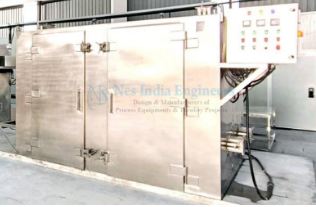 | Batch Dryers Nes India Engineers are the most leading Manufacturers, Suppliers, Exporters of Atmospheric Tray Dryers in India, Pune, Aurangabad, Goa, Chennai,... View product → |
Frequently asked questions
How does atmospheric batch drying work from loading to unloading?
You load material in a defined layer on trays, close the chamber, heat and circulate air, exhaust moisture-laden air, verify the endpoint, then unload after cooling and safety checks.
How do you match the feed and batch recipe to the dryer?
Match tray area, layer thickness, wet mass, moisture content, particle or paste form, drying temperature, airflow and batch time to the dryer’s usable capacity and recipe controls.
Which dryer construction details control uniformity and contamination?
Check airflow distribution, shelf spacing, door seals, tray fit, internal weld quality, surface finish, drainability and access for cleaning and inspection.
How should the batch end point, safety review and documentation be controlled?
Define the endpoint with moisture, loss-on-drying, weight or product-temperature criteria, then review alarms, over-temperature protection, interlocks, records and batch-release documents.
How do you compare atmospheric tray drying with other equipment and suppliers?
Compare drying time, product handling, capacity, heat sensitivity, cleaning effort, containment, energy use, validation records, test results, fabrication quality and after-sales support.