
A double cone blender is not automatically suitable for every mineral powder, and its nameplate capacity does not tell you how many tonnes it will produce per shift. By checking flow behaviour, wear, dust hazards, usable volume, discharge performance, and factory-test evidence, you can compare suppliers and specify a machine that fits your Pune plant.
Key takeaways
- Test flowability, moisture, bulk density, and abrasiveness before choosing.
- Size from working volume and bulk density, not vessel volume alone.
- Choose double cone, octagonal, or ribbon mixing from powder behaviour.
- Specify liner material, seals, dust extraction, and acceptance tests.
How a Double Cone Blender Handles Mineral Powder
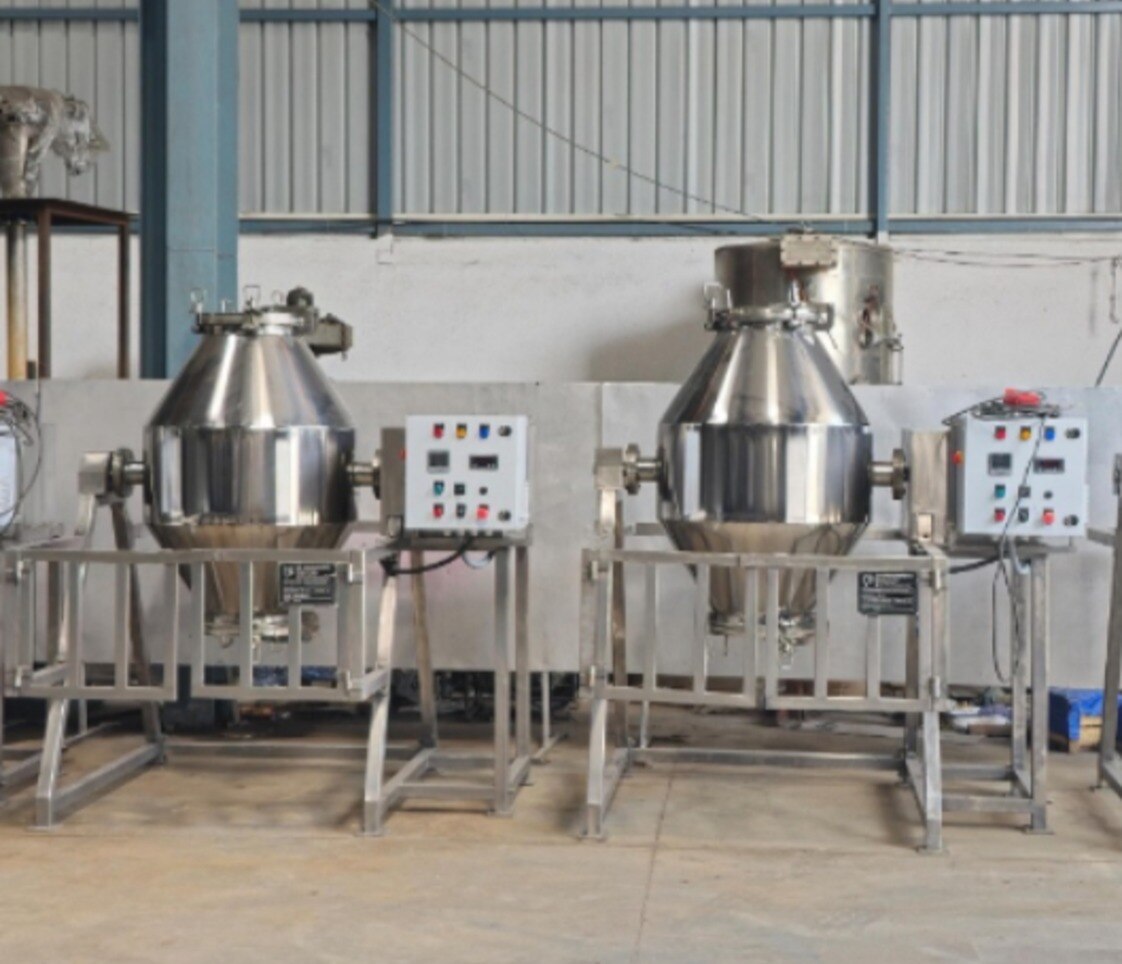
A double cone blender working principle is simple: load mineral powder through the charging port, rotate the vessel around its horizontal axis, and let gravity repeatedly lift and drop the bed. Cascading and rolling move particles across both cone sections, while the bottom outlet empties the batch after mixing.
The working fill level matters; operating at roughly 30–70% of geometric volume leaves space for axial turnover. Overfilling reduces movement and can leave unmixed zones.
| Feed condition | Fit for low-shear mineral powder mixing | Main risk |
|---|---|---|
| Dry, free-flowing, non-cohesive powder | Good fit | Fines can percolate downward and segregate |
| Dry abrasive powder | Possible with wear-resistant liners and seals | Liner, cone, and outlet wear |
| Damp, cohesive, or caking powder | Poor fit without conditioning | Lumps remain intact |
| Electrostatic or fibrous powder | Usually poor fit | Wall adhesion and incomplete discharge |
| Strongly agglomerated powder | Poor fit | Tumbling will not break hard agglomerates |
Silica sand, mineral fillers, ceramic powders, pigments, and other free-flowing solids suit this action when their moisture and particle-size distribution remain controlled. Wet or sticky feeds need drying or a pre-breaker; hard agglomerates may need an intensifier bar or a different mixer.
For blends with widely different particle sizes, run a uniformity trial because continued rotation can worsen segregation rather than correct it.
The Feed Tests That Should Decide Your Purchase
A supplier cannot defend a uniformity claim from vessel volume or a nameplate mixing time. Provide test material from the actual mineral process, because fines can segregate by percolation while coarse particles roll toward the vessel wall during tumbling and discharge.
Give the laboratory these feed measurements:
- Bulk density at minimum and maximum expected values, including loose and tapped density where available.
- Particle-size distribution with sieve or laser-analysis results, including the proportion of fines and coarse particles.
- Moisture content at normal operation and the highest expected excursion.
- Angle of repose, flowability observations, cohesion, friability, abrasiveness, and electrostatic behaviour.
- The required blend-uniformity result, assay method, sample mass, number of samples, and sampling locations.
| Data set | Provide before the claim | Why it matters |
|---|---|---|
| Plant batch data | Target mass, occupied volume, fill percentage, rpm, batch cycle, and discharge time | A vessel can meet tonnes per batch yet exceed its workable volume. |
| Trial record | Actual feed or a documented surrogate with matching bulk density, particle-size distribution, moisture content, and flowability | An unmatched powder proves little. |
| Uniformity evidence | Composition results from agreed points before discharge and across the discharged batch | A single sample can hide segregation. |
| Mechanical and site data | Motor current or torque, residual hold-up, dust leakage, ambient temperature, monsoon humidity exposure, electrical supply, washdown policy, and dust classification | These values expose overload, retention, and installation risks. |
Sizing the Blender for Mass, Volume, and Shift Output
Use the lowest bulk density to calculate occupied volume: volume equals batch mass divided by bulk density. A 2,000 kg batch ranging from 0.8 to 1.2 t/m³ occupies 2.5 m³ at its loosest state, not 1.67 m³ at its densest.
Size around gross volume versus working volume. A double cone normally runs at 30 to 70 percent fill, so a 2.5 m³ maximum occupied volume at a 50 percent target requires a 5 m³ gross vessel. State both figures in the quotation; otherwise “5 m³ capacity” can conceal a much smaller usable batch.
- Fix the batch size in kilograms and calculate occupied volume at the lowest and highest measured bulk densities. Use the low-density result to prevent overfilling and the high-density result to check discharge and load limits.
- Convert shift demand into batches: divide required tonnes per shift by the accepted batch mass, then round up. Multiply that count by charging time, mixing time and batch capacity, discharge time, and planned cleaning or inspection time.
- Check that the resulting cycle fits the shift with recovery time for delays. If 16 tonnes require eight 2,000 kg batches and each complete cycle takes 45 minutes, production needs six scheduled hours before cleaning or stoppages.
Specify the drive from the heaviest bulk-density case, maximum fill, moisture excursion, cold start, and any intensifier. Require calculated starting and running torque, gearbox rating, motor current, and discharge torque; variable-frequency control cannot rescue an undersized drive.
Double Cone, Octagonal, or Ribbon: Which Design Fits?
Choose a double cone for dry, free-flowing minerals when gentle tumbling, low power demand, and rapid dry cleaning matter most. For a double cone versus octagonal blender decision, compare the actual powder, not vessel shape alone.
| Design | Cohesion and deagglomeration | Segregation risk | Power, cleaning, and discharge |
|---|---|---|---|
| Double cone | Best for non-cohesive powders; no intensive deagglomeration | Moderate if particle size or density differs | Lowest power; simplest dry cleaning; use a flush, full-opening outlet |
| Octagonal | Stronger cascading and more mixing paths; limited lump breaking | Moderate; verify first, middle, and last discharge fractions | Higher power than double cone; more internal surfaces to clean; outlet design controls hold-up |
| Ribbon | Better for cohesive powders and controlled convective mixing; optional choppers break soft lumps | Lower for some cohesive blends, but overmixing can separate fractions | Highest power; more seals and surfaces; inspectability and complete discharge need proof |
A ribbon blender comparison should include torque at the worst-case moisture and bulk density, not only motor kilowatts. A plain ribbon will not replace intensive deagglomeration equipment for hard agglomerates; specify an intensifier bar, pre-breaker, or high-shear mixer when required.
Treat cleaning and discharge as one decision. Dry cleaning avoids caking and corrosion, while a small butterfly valve can retain fines and raise cross-contamination risk. Require the supplier to measure residual mass and composition RSD from first, middle, and last discharge samples.
Specify Wear, Dust Control, Construction, and Acceptance Tests
Quartz and silica can destroy an attractive polished finish. Specify an abrasion-resistant blender with replaceable wear liners at the cone interior, welds, outlet, and other impact zones; use 316L only where contamination control justifies it, not as a substitute for wear design.
1. Put the construction requirement on the purchase order: liner material and thickness, shaft and outlet material, weld finish, bearing protection, drainability, and access through the charging cover, inspection door, cone apex, and discharge valve.
2. Require dust-tight seals at the drive shaft, charging cover, inspection door, and outlet. Define the vent connection, dust-extraction flow, filter isolation, cleaning access, and leakage inspection. State the Pune site electrical supply, ambient temperature, monsoon humidity, washdown policy, motor enclosure, cable-gland rating, panel ingress protection, earthing, and dust classification.
3. Choose dry cleaning where residual water could cake or hydrate the mineral, corrode surfaces, or obstruct discharge. If wet cleaning is unavoidable, require cleanable seals, full drainage, drying provisions, and a numerical residual-moisture or cleanliness limit.
4. Witness a factory acceptance test using your powder or a surrogate matching bulk density, particle-size distribution, moisture, and flowability. Record fill mass, occupied volume, rpm, mixing time, motor current or torque, discharge time, residual hold-up, dust leakage, and composition at agreed sampling points.
Ask Nes India Engineers to include blend-uniformity results and signed test conditions in the order, rather than accepting a nameplate mixing time as proof of performance.
Related product
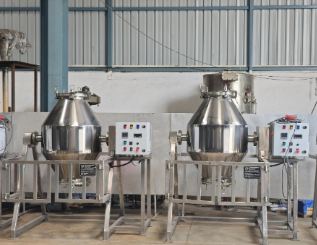 | Blenders Nes India Engineers are the most leading Manufacturers, Suppliers, Exporters of Double cone blender in India, Pune, Aurangabad, Goa, Chennai, Mumbai,... View product → |
Frequently asked questions
How does a double cone blender handle mineral powder?
A horizontal rotating vessel repeatedly lifts and drops the powder, creating cascading and rolling movement across both cone sections before discharge.
Which feed tests should decide a mineral powder blender purchase?
Test bulk density, moisture, flowability, particle-size distribution, cohesion, and abrasiveness using a representative feed sample.
How do you size a double cone blender for mass and shift output?
Convert the required batch mass using measured bulk density, then allow for the blender’s working fill range, cycle time, loading, mixing, and discharge time.
When should you choose a double cone, octagonal, or ribbon blender?
Choose a double cone for gentle tumbling, an octagonal blender for broader cascading movement, and a ribbon blender when stronger convective mixing suits the powder.
What should you specify for a mineral powder blender?
Specify abrasion-resistant contact surfaces, suitable seals, dust extraction, construction materials, cleaning access, discharge design, and documented acceptance tests.