
An urgent powder-blending order can fail even when a vessel is available: the recipe may segregate, the discharge may retain product, or sanitation and commissioning may take longer than production allows. You will be able to screen the powder, compare usable capacity and hygiene details, verify genuine readiness, and issue a purchase checklist that protects your delivery date.
Key takeaways
- Test flowability, fibre length and segregation risk before choosing a ribbon blender.
- Calculate working volume from bulk density, fill ratio and required batch output.
- Specify sanitary welds, inspection access, drainability and validated cleaning procedures.
- Confirm stock, fabrication lead time, drawings and factory acceptance testing in writing.
Is a ribbon blender suitable for your food powder?
Flour, spices, seasoning, premix, sugar, salt, milk powder and many nutraceutical powders are suitable starting candidates for a ribbon blender when they flow freely and contain only short fibres. A food processing blender is not automatically suitable for every recipe.
Cohesive, heat-sensitive, fragile or segregation-prone powders need an actual trial. Record:
- Bulk density, particle-size distribution and moisture
- Cohesion, abrasiveness and fat content
- Segregation risk during mixing, discharge and transfer
- Whether the formulation requires liquid addition
Liquid addition changes the equipment requirement. A poorly positioned spray nozzle can wet one area, creating lumps, wall build-up and higher torque. Ask for the nozzle arrangement, liquid-rate range, atomisation method and torque allowance.
Provide a representative sample or complete formulation data, including ingredient proportions and target moisture. Request a trial that measures blend uniformity at multiple sampling points, with defined sample mass, assay or marker method, acceptance criterion and repeat batches.
A promised mixing time alone proves little: one sample can look uniform while another zone remains rich or deficient in a key ingredient. Also confirm that the discharge leaves no unacceptable powder heel, especially where fat or sticky components could increase cross-contact and cleaning problems.
How do you calculate the batch size and blending performance you need?
Usable working volume is not the vessel’s gross volume. A 2 m³ shell may require headspace and operate at a 40–80% fill ratio, while the batch mass depends on the powder’s stated bulk density. A ribbon blender manufacturer for urgent food production in Pune must quote both limits for your actual product.
- Request minimum and maximum batch sizes in cubic metres and kilograms, based on measured loose and tapped bulk density. Record working speed, motor power, expected mixing time, discharge time and allowable residual hold-up.
- Require a trial protocol naming sampling locations, sample mass, assay or marker method, blend-uniformity acceptance criterion and repeat-batch count. A fixed “10-minute mix” proves little without results from multiple points.
- Compare ribbon-to-trough clearance, discharge-valve type, powder heel after emptying and clean-out access. Ask the supplier to demonstrate the required range without excessive torque, stalled discharge or visible segregation.
- Put capacity, density range, speed, motor rating, valve, trial evidence, cleaning method, documents and exclusions in one process-and-document matrix. Vessel volume alone can hide a production delay.
| Comparison | What to check | Why it matters |
|---|---|---|
| Capacity basis | Gross volume, fill ratio, loose and tapped density | Prevents an inflated kilogram claim |
| Discharge | Valve design, heel mass, clean-out access | Protects yield and changeover time |
| Performance | Torque, segregation, uniformity results | Shows whether the full batch range is practical |
Which food-hygiene and cleaning details must be specified?
A cleanable ribbon blender is defined by its product-contact details and demonstrated release procedure, not by a polished exterior. Ask the food powder blender supplier to identify the exact stainless-steel grade, internal surface finish, hygienic weld standard, passivation records where applicable, gasket and shaft-seal materials, inspection-cover design, crevice controls and accessible discharge surfaces.
Reject an unqualified “SS” description.
Request these details in writing:
- Product-contact material certificates, elastomer declarations and weld or surface-finish records
- Ribbon-to-trough clearance, shaft-seal arrangement, gasket grooves and dead-leg controls
- Discharge-valve design, residual powder hold-up and access to every product-contact surface
- Cleaning, inspection and complete changeover time estimates
| Cleaning mode | What to verify | Main risk |
|---|---|---|
| Dry cleaning | Vacuum, brushing and access without water | Residual allergen in seals, grooves or corners |
| Wet cleaning | Drainability, detergent compatibility and drying time | Trapped moisture, corrosion or microbial growth |
| Clean-in-place | Spray coverage, validated cycle and drain points | Shadowed surfaces remain contaminated |
For allergens or potent ingredients, demand cleaning evidence from trials or swab and rinse results covering the ribbon, trough, seals, valves and liquid-addition nozzles. Also provide a dust-hazard assessment using Kst, Pmax and minimum ignition energy.
Specify bonding and grounding, extraction, isolation, suitable electrical equipment, and explosion venting or suppression where the powder data requires them.
How can you verify ribbon blender availability near Pune?
Verify ribbon blender availability by requesting a dated readiness statement, not accepting “machine available” in a quotation. A usable system includes the blender and every item needed to run production.
Ask the ribbon blender manufacturer in Pune to state the status of:
- Vessel, drive, discharge valve, control panel, safety guarding, product-contact gaskets and dust-extraction connection
- General arrangement, electrical drawings, operating manual, cleaning instructions and inspection records
- Items in stock, items fabricated, items awaiting manufacture or procurement, and the inspection date
- Dispatch date, installation scope, site requirements and commissioning date
| Status | Evidence to request | Production risk |
|---|---|---|
| In stock and inspected | Photographs, serial numbers, inspection record and dispatch condition | “Available” equipment may still lack controls or guards |
| Fabricated but incomplete | Remaining parts, procurement dates and responsible party | Gaskets, valves or panels can extend the lead time |
| Quoted only | Manufacturing schedule and firm completion date | Vessel volume alone proves nothing |
Local proximity can reduce travel time, but it does not prove a short lead time. Compare Nes India Engineers or another supplier using a process-and-document matrix covering batch range, electrical supply, dust interface, spare parts, operator training and every exclusion.
Set the factory acceptance test before issuing the order. Use your recipe or a representative surrogate where possible, and check blend uniformity, discharge, motor current, interlocks, emergency stop, leakage, noise, vibration and dust connections—not only unloaded rotation.
Related product
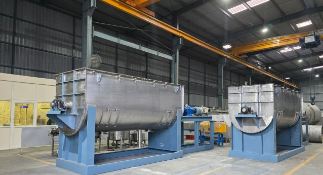 | Blenders NES India Engineers are the most leading Manufacturers, Suppliers, Exporters of Ribbon blenders in India, Pune, Aurangabad, Goa, Chennai, Mumbai,... View product → |
What should an urgent purchase order and acceptance test include?
A quotation becomes a deliverable system only when the purchase order fixes the recipe, scope and dates. State these details explicitly:
- Product name, formulation or representative sample, target batch mass, bulk-density range and required capacity.
- Food-contact materials, including stainless-steel grade, elastomer declarations and surface-finish requirements.
- Cleaning method: dry cleaning, wet cleaning or clean-in-place, with the expected changeover procedure.
- Electrical supply, control-panel requirements, delivery location, installation date, commissioning scope, operator training and production start date.
- Complete-system availability, covering the blender, drive, discharge valve, guarding, control panel, product-contact gaskets, dust connection, drawings, spares and installation support.
Attach a document schedule to the order. Request material certificates, food-contact declarations for elastomers, equipment drawings, operating and maintenance instructions, weld and surface-finish records, passivation records where applicable, calibration certificates, test records and change-control documentation. Record every exclusion that could delay dispatch or production.
Define the factory acceptance test before fabrication. Use your recipe or a representative surrogate, not unloaded rotation alone, and record:
- Rotation direction and motor current.
- Interlocks, guarding and emergency-stop operation.
- Discharge operation, leakage and dust-connection integrity.
- Noise and vibration readings.
- Blend uniformity from agreed sampling points and an agreed acceptance limit.
Before release, confirm that installation and operating controls fit the site’s Food Safety and Standards Authority of India system for allergen segregation, sanitation, foreign-body prevention, traceability and cleaning validation. Supplier equipment compliance does not replace those controls.
Frequently asked questions
Is a ribbon blender suitable for your food powder?
Use one for free-flowing powders such as flour, spices, seasoning, sugar, salt, milk powder and premixes with short fibres. Check segregation, moisture, heat sensitivity and fibre length before approval.
How do you calculate the batch size and blending performance you need?
Convert the required mass to volume using bulk density, then select a working volume within the blender’s stated fill range. Confirm blend uniformity using samples from multiple locations and a defined mixing time.
Which food-hygiene and cleaning details must be specified?
Specify stainless steel grade, sanitary weld finish, crevice-free internal geometry, access covers, seals, drainability, dust control and the cleaning method. Require material certificates, surface-finish records and inspection documents.
How can you verify ribbon blender availability near Pune?
Ask for the available model, usable volume, motor details, dispatch date, fabrication status, inspection schedule, installation scope and spare-parts availability. Separate ready stock from equipment that still needs fabrication.
What should an urgent purchase order and acceptance test include?
State powder properties, batch mass, target blend uniformity, cycle time, load limits, safety interlocks, documentation, delivery milestones and rejection criteria. Test empty running, loaded operation, discharge, cleanability and blend samples before acceptance.