
Grains, pulses, spices, sugar crystals, tea and similar free-flowing foods can benefit from rotary drying, but a dryer selected from a nominal tonnes-per-hour figure can still produce scorching, uneven moisture or costly product loss. You will be able to match the feed to the drying method, define the data a supplier needs, specify hygiene and safety controls, and verify performance before accepting the equipment.
Key takeaways
- Use rotary dryers for free-flowing foods that tolerate controlled heat and repeated lifting.
- Avoid sticky, oily or heat-sensitive feeds unless the design addresses adhesion and quality loss.
- Specify product moisture, throughput, heat source, airflow and hygiene requirements in the quotation.
- Compare dryers using measured moisture, product temperature, cleaning access and test-batch results.
Which food products are a practical fit for rotary drying?
A rotary dryer is practical for free-flowing, granular or particulate foods that tolerate controlled heat and repeated lifting. Grains, pulses, spices, tea, sugar crystals, animal-feed pellets, fruit pieces and vegetable flakes can fit; sticky, sugary, oily or heat-sensitive feeds often adhere to the shell and flights, agglomerate or lose colour and aroma.
| Feed type | Practical fit | Main risk |
|---|---|---|
| Grains and pulses | Strong fit when free-flowing | Uneven drying or kernel breakage |
| Spices and tea | Fit with controlled product temperature | Aroma loss, scorching and fines |
| Sugar crystals and pellets | Fit if surfaces remain non-tacky | Melting, sticking and agglomeration |
| Fruit pieces and vegetable flakes | Fit after size and feed-condition trials | Case hardening, breakage and clumping |
| Sticky, oily or heat-sensitive material | Poor fit without a specialised design | Shell deposits, oxidation or quality loss |
A pilot using the actual formulation, particle-size distribution and feed condition matters more than a supplier’s nominal evaporation capacity. Test wettest and driest fractions, fines and agglomerates, then specify cooling and moisture equalisation: a hot product can condense inside packaging, while moisture migration can make a passing batch fail later.
A rotary dryer food plant in Kolkata must design beyond the hot zone.
Assess the feed using:
- Initial moisture and target moisture
- Bulk density and particle-size range
- Stickiness, oil content and heat sensitivity
- Allowable residence time and breakage risk
- Feed temperature and expected product temperature
- Required cooling time before packing
How should heating and airflow be selected for food safety?
Choose indirect heating or a clean-air heat exchanger when smoke, combustion by-products or flavour carryover could damage the food. Direct-fired designs place combustion gases in contact with the product, so specify burner-failure shutdown, flame-safeguard protection and high-temperature interlocks.
An industrial food dryer supplier must state fresh-air fraction, recirculation temperature, exhaust humidity, fan power and heat-recovery assumptions; high recirculation can concentrate odours and fine dust.
| Arrangement | Benefit | Main food-safety risk |
|---|---|---|
| Direct-fired, co-current | Hottest air meets wet feed while evaporative cooling is greatest | Combustion contamination or local overheating |
| Indirect or clean-air, co-current | Protects flavour and avoids combustion-gas contact | Higher heat-transfer complexity and slower response |
| Direct-fired, counter-current | Supports lower final moisture potential | Dry product meets the hottest air near discharge |
| Indirect or clean-air, counter-current | Combines clean air with strong finishing capability | Drying damage if product temperature rises at discharge |
Separate exhaust-air temperature from product temperature. Put these values in the purchase specification and acceptance record:
- Inlet and outlet air temperatures
- Maximum product temperature, residence-time range and sampling method
- Dust classification, bonding and grounding, ignition-source controls, explosion venting or suppression, and isolation between connected equipment
- Dust-collector type and protection: a cyclone or bag filter removes dust but is not complete explosion protection
Select the collector for the measured dust loading, particle size and explosion-risk assessment. A failed temperature trip or unisolated duct can turn a dryer fault into a fire or dust explosion.
What must be included in the dryer design and Kolkata site quotation?
A comparable quotation starts with a mass balance, not “tonnes per hour.” State kilograms of water evaporated per hour against feed rate, inlet and outlet moisture percentages, feed temperature, target product temperature, ambient humidity and planned operating hours.
1. Give the supplier a fixed design basis. Record the required evaporation rate, product throughput and acceptable moisture variation, then ask for the calculated drum diameter and length. A rotary dryer manufacturer in Kolkata should also state the assumed heat loss and operating margin.
2. Demand a residence-time explanation. Drum slope, rotational speed, flight geometry, fill level, airflow and particle size determine residence-time distribution; they control drying uniformity, fines, breakage and agglomerates. A nominal average residence time cannot prove that every particle reaches specification.
3. Separate the machine price from the installed-cost estimate. Require stainless-steel product-contact surfaces, smooth welds, sanitary seals, accessible inspection doors, cleanable internals, dust-tight discharge points and complete drainage. Price Kolkata site interfaces separately:
- Burner fuel quality, electrical supply, compressed air and cooling water
- Stack height, duct routing, foundation loads and dust-collector location
- Cyclone, baghouse, scrubber or other exhaust treatment selected from measured dust, odour and volatile loading
Check West Bengal Pollution Control Board consent and emission conditions before fixing the stack. Require fresh-air fraction, recirculation temperature, exhaust humidity, fan power and heat-recovery assumptions; high recirculation can concentrate odours and dust while making efficiency figures look better.
How do you control moisture, quality and hygiene after drying?
A lower moisture reading does not prove a stable food. Sample the feed, cooler discharge and packed product from defined locations, then compare results with written limits for final moisture, moisture variation, water activity (aw), colour, aroma, scorching, case hardening, oxidation and breakage.
| Check | Defined method | Acceptance basis |
|---|---|---|
| Moisture and aw | Test wettest, driest, fine and coarse fractions; repeat after moisture equalisation | Product specification; aw below 0.60 is commonly treated in FDA guidance as preventing growth of bacteria, yeasts and moulds |
| Quality | Record colour change, aroma loss, scorch marks, hard particles, oxidation and broken pieces | Agreed colour value, sensory standard and maximum defect percentage |
| Stability | Retest after storage in the intended package | Product-specific validation, with packaging that prevents moisture and oxygen ingress |
A post-dryer cooler and equalisation hold are essential. Hot food can condense water inside a sealed pack, while moisture migrates from wetter particles into drier ones and turns a passing batch into an unstable one. Validate the aw limit for the formulation; packaging controls still matter.
Request these hygiene documents before approval:
- Material certificates for every product-contact surface
- Weld-finish limits, smoothness requirements and photographs of completed welds
- Drainability drawings showing no liquid traps
- Accessible inspection points and a documented cleaning procedure
- HACCP records identifying hazards, critical or operational limits, monitoring points, corrective actions and verification, aligned with FSSAI hygiene records
Generic chemical-process construction does not prove sanitary food design.
How should you test and compare a rotary dryer manufacturer’s offer?
Select the offer by proving performance on your product, not by accepting a catalogue capacity. Require a pilot or factory-acceptance trial with a defined feed lot, your actual formulation and particle-size distribution, then repeat the agreed test as a site-acceptance test in Kolkata.
Record these measurements in both test reports:
- Feed rate, initial and final moisture, and water activity where relevant
- Product temperature, exhaust temperature, fuel or steam consumption, and pressure drop
- Dust carryover, residence-time range, and percentage of off-specification product
- Samples from the wettest and driest fractions, plus fines and agglomerates
A nominal average residence time proves nothing about uniformity. Flights, shell speed, slope, fill level and particle size create a residence-time distribution, so inspect the extremes before accepting the dryer.
Compare offers on the same mass balance: kilograms of water evaporated per hour, inlet and outlet moisture, feed and product temperatures, ambient humidity and operating hours. Also compare cleanability, food-contact materials, sanitary welds, utilities, dust control, safety interlocks, HACCP records, heat recovery and installed interfaces.
| Area | Ask the supplier to state | Why it matters |
|---|---|---|
| Capacity | Water evaporated per hour at named conditions | “Tonnes per hour” can hide different moisture loads |
| Air system | Fresh-air fraction, recirculation temperature, exhaust humidity and fan power | Recirculation saves fuel but can concentrate odour and dust |
| Acceptance | Off-specification limit and sampling method | It converts a promise into a warranty measure |
Nes India Engineers is worth comparing only through its proposed design, trial evidence, food-contact documentation and acceptance procedure against your product and HACCP records.
Related product
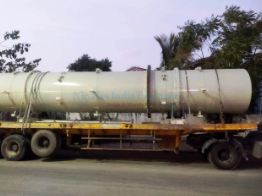 | Continuous Dryer A Rotary Dryer is a robust and highly efficient industrial drying system designed to reduce the moisture content of a wide range of bulk solids. View product → |
Frequently asked questions
Which food products suit a rotary dryer?
Free-flowing, granular or particulate products such as grains, pulses, spices, tea, sugar crystals, animal-feed pellets, fruit pieces and vegetable flakes are practical fits when they tolerate controlled heat and repeated lifting.
Which food products are difficult to dry in a rotary dryer?
Sticky, sugary, oily or heat-sensitive feeds can adhere to the shell and flights, agglomerate, lose colour or lose aroma.
What should a Kolkata food plant include in a rotary dryer quotation?
State the feed material, starting and target moisture, throughput, particle size, product temperature limit, heat source, airflow arrangement, cleaning access, contact-material specification and installation conditions.
How do you compare rotary dryer manufacturers?
Compare test-batch results, final moisture uniformity, product temperature, residence-time control, energy use, dust handling, cleaning access, inspection records and the completeness of the site quotation.