
A quotation for a tray dryer can say “complete unit” while leaving trays, sensors, ducting, installation and utility connections undefined. By the end, you will have a line-by-line checklist for comparing the supplied equipment, process performance, documentation and commercial terms before placing an order.
Key takeaways
- Request a line-by-line equipment list, not “complete dryer.”
- Confirm tray count, usable capacity and product-contact material grades.
- Match airflow, heater output and controls to the batch cycle.
- Separate included work, options, installation and after-sales service.
Read the quotation as a list of equipment, not a single package
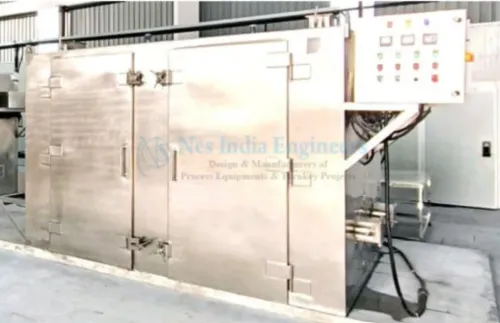
A conventional atmospheric tray dryer purchase should name each physical assembly, not hide it behind “complete dryer.” The quoted tray dryer equipment inclusions should identify the insulated drying chamber, hinged access door, internal air-distribution arrangement, recirculation blower, fresh-air and exhaust-air dampers, heater, temperature controller, temperature sensors, control panel, and fixed or wheeled tray-support trolley.
Ask the supplier to mark each item as included, optional, or excluded:
- Chamber insulation and external cladding
- Tray trolley, trolley wheels, and handles
- Trays, with quantity, dimensions, material, and solid or perforated construction
- Recirculation blower and motor
- Fresh-air inlet, recirculation damper, and exhaust damper
- Heater, heater supports, and guards
- Temperature sensors, controller, panel wiring, and basic safety interlocks
The heater itself does not prove that the heating utility is included. Record exactly what arrives with the atmospheric tray dryer purchase.
| Heating arrangement | Included equipment | Confirm or exclude |
|---|---|---|
| Electric | Heater, controls, wiring inside the panel | Transformer, feeder cable, and electrical installation |
| Steam | Steam coil and condensate connections | Steam generator, valves, traps, and steam piping |
| Thermic fluid | Thermic-fluid coil and connections | Thermic-fluid heater, pump, and piping |
| Gas or hot air | Burner or hot-air system | Gas train, compressor, stack, and room ventilation |
Also state whether exhaust ducting, filters, lifting equipment, spare heaters, spare sensors, gaskets, and validation documents are supplied. A trolley with no trays, or a heater with no utility package, is not a complete installed dryer.
Confirm the trays, usable capacity and product-contact materials
A quoted “12-tray dryer” does not tell you the batch you can actually dry. Tray dimensions, spacing, loading depth, and product density determine usable capacity, so treat tray dryer equipment inclusions as measurable line items rather than implied accessories.
- State the exact tray count, length, width, working area, thickness, and clear spacing between trays.
- Record usable batch capacity in kilograms and maximum loading depth per tray; gross cabinet volume is not a capacity guarantee.
- Specify whether each tray is solid, perforated, mesh, or supplied with a product-specific liner. Additional trays and liners are often priced separately.
- Name the product-contact material and finish, such as stainless steel 304 or 316L with polished surfaces, and state whether welds, corners, and edges are smooth enough to clean without residue traps.
The order should also identify the tray trolley and confirm that its capacity matches the quoted tray count. A quotation that includes only the trolley and a nominal number of trays leaves you paying extra to fill the cabinet.
Tie capacity to a loading pattern and product test, not only to heater size. Write the expected kilograms per batch, kilograms per tray, initial and final moisture, and loading depth into the purchase specification; otherwise, “uniform drying” can describe a smaller load than the one you intend to run.
Match airflow and heating to the product and batch cycle
The proof is a defined performance trial, not a heater rating. Write the usable batch capacity, test material, starting and final moisture, loading pattern, tray depth, inlet-air temperature, relative humidity, airflow condition and expected drying time into the quotation.
| Specification | Credible commitment | Weak substitute |
|---|---|---|
| Test basis | Named product or representative material, initial and final moisture, stated loading per tray | “Suitable for powder drying” |
| Air movement | Recirculation ratio, fresh-air inlet, exhaust rate or air changes, plus airflow direction | “High-capacity blower” |
| Temperature | Design temperature, normal operating temperature and measured uniformity across loaded trays | “Uniform hot air” |
| Endpoint | Moisture limit, sampling method and acceptance point at the stated drying time | “Fast drying” |
| Capacity | Kilograms of usable product at the specified loading depth | Gross cabinet volume or heater kilowatts |
Ask how the manufacturer will demonstrate the result: identify sample locations, number of trays tested, temperature-recording points and the permitted moisture variation between samples. Without those conditions, “uniform drying” cannot be compared between quotations.
For an atmospheric tray dryer purchase, confirm whether heating uses electric elements, steam coils, thermic fluid or a gas-fired hot-air system. Identify excluded utilities such as a steam generator, thermic-fluid heater, gas train, transformer or compressor.
A near-atmospheric recirculating cabinet is not a vacuum or inert dryer; solvent-wet, oxygen-sensitive or heat-sensitive products need a separate safety and process-design review.
Specify controls, electrical supply, safety and documentation
Treat tray dryer equipment inclusions as contractual line items, not as an implied “complete package.” State the control functions, incoming power, safety devices and documents beside each item so an omitted component cannot appear after order placement.
1. Name the control-panel functions: temperature indication and control, timer, batch-cycle status, high-temperature alarm, independent high-temperature cut-out, emergency stop, password-controlled set points, and data logging or chart recording. Identify calibrated RTD or thermocouple sensors, sensor quantity and location, and whether calibration certificates are included.
2. Write the electrical supply as 415 V, three-phase, 50 Hz, then record connected load in kW and full-load current. Confirm inclusion of the incoming isolator, motor starters or VFDs, overload protection, earthing terminals, panel-to-dryer cable lengths, heater wiring and terminal markings.
3. Specify safety provisions: guarded blower and heater sections, door interlock where access creates a hazard, emergency-stop circuit, overload trip, independent temperature cut-out and an alarm that remains visible until acknowledged. Do not treat a temperature controller alone as process protection.
4. List the records supplied at handover: general arrangement drawing, utility and electrical load list, product-contact material certificates, surface-finish declaration, instrument calibration certificates, operating and maintenance manuals, spare-parts list, and factory test or inspection records.
Record the warranty start point, service response time, replacement-heater and sensor availability, and travel charges for visits outside the supplier’s local area. If the atmospheric cabinet will handle solvent-wet, oxygen-sensitive or heat-sensitive material, require a separate vacuum, inerting or solvent-recovery design review.
Separate included work from options, installation and service terms
Compare quotes by responsibility, not by the word “complete.” A tray dryer manufacturer in Kolkata may include fabrication while charging separately for unloading, utility connection, commissioning or performance testing.
| Item | Included in the price | Confirm or price separately |
|---|---|---|
| Delivery | Delivery to the named Kolkata site | Unloading, crane, positioning and transit insurance |
| Installation | Assembly and supervision | Foundation, ducting, piping, cabling and civil work |
| Commissioning | Trial run with agreed product or test load | Performance testing, validation protocol and operator training |
| Warranty | Defect warranty from dispatch or commissioning | Warranty start point, exclusions and response time |
| Service | Telephone support and specified visits | Travel charges outside the local area, labour and spare parts |
Use a written schedule when comparing a tray dryer manufacturer for purchase inclusions in Kolkata. Mark each item as included, optional or excluded:
- Spare heaters, temperature sensors, filters, gaskets and trolley wheels
- Exhaust duct, room ventilation and electrical cabling
- Safety interlocks, manuals, drawings and calibration records
- Replacement-part availability and the service response time
Ask whether warranty begins at dispatch, delivery, installation or acceptance; the difference affects usable cover when site preparation delays commissioning. Nes India Engineers can be compared on the same terms by requesting those dates, exclusions and service charges in the quotation.
Finally, confirm the process boundary. An atmospheric tray dryer operates near atmospheric pressure and is not a vacuum dryer; solvent-wet, oxygen-sensitive or combustible-dust products need a separate vacuum, inerting, exhaust-treatment or hazardous-area review.
Related products
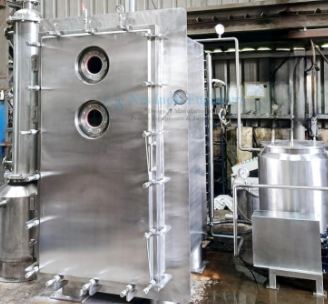 | Batch Dryers We Ness India Engineers from Pune, Maharshtra, India are a leading manufacturer, supplier and exporter of vacuum tray dryer in India. View product → |
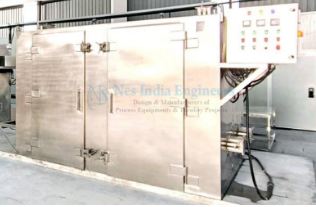 | Batch Dryers Nes India Engineers are the most leading Manufacturers, Suppliers, Exporters of Atmospheric Tray Dryers in India, Pune, Aurangabad, Goa, Chennai,... View product → |
Frequently asked questions
What equipment inclusions should a tray dryer quotation list?
The quotation should identify the insulated drying chamber, hinged access door, air-distribution arrangement, recirculation blower, fresh-air and exhaust-air dampers, heater, temperature controller, sensors, control panel and tray-support trolley.
What should you confirm about trays and usable capacity?
Confirm the tray count, tray dimensions, loading depth, usable chamber volume, batch capacity and product-contact materials. Ask whether capacity refers to gross chamber volume or actual product loading.
How do you match airflow and heating to the product?
Check air velocity, recirculation rate, fresh-air and exhaust-air control, heater type and temperature range against the product’s moisture content, heat sensitivity and required batch drying time.
Which controls, safety features and documents belong in the purchase specification?
Specify the electrical supply, control-panel functions, temperature sensors, over-temperature protection, emergency stop, interlocks, wiring drawings, operating manual, test records and material certificates where required.
How should you separate included work from options and service terms?
List installation, commissioning, freight, utility connections, operator training, validation support, spare parts, warranty duration and response times separately from optional accessories and the base equipment price.