
A mineral-chemical plant can lose capacity, product quality and cleaning time by treating a storage tank as a mixing vessel, or by specifying pharmaceutical hygiene where abrasive slurry service demands different priorities. You will be able to match the vessel type to the process, set the material and agitator requirements, size the equipment correctly and assess a manufacturer’s technical submission.
Key takeaways
- Select vessels by heat transfer, blending, gas dispersion or solids suspension duty.
- Specify materials and pressure limits for the harshest batch condition.
- Size the agitator for particle settling, viscosity and required suspension quality.
- Request drawings, calculations, tests and maintenance documents before purchase.
Choose the Vessel Around the Process Duty, Not the Product Name
Choose a mixing vessel, process tank, storage tank or chemical reactor from the process duty, not the product name. An industrial mixing vessel is built for heat transfer, solids suspension, gas dispersion or liquid blending.
A storage tank is built mainly for containment, residence time, cleanliness and controlled withdrawal; a pharmaceutical storage tank adds strict drainability and contamination control. A reactor must be specified around the reaction, temperature profile, pressure and residence time.
| Option | Primary design purpose | Key specification |
|---|---|---|
| Mixing vessel | Heat transfer, blending, gas dispersion or solids suspension | Impeller duty, power, speed, heat-transfer conditions and homogeneity |
| Process tank | Batch holding with controlled processing | Working volume, temperature, residence time and transfer connections |
| Storage tank | Containment and controlled withdrawal | Cleanability, residence time, outlet design and material compatibility |
| Chemical reactor | Chemical reaction under defined conditions | Reaction kinetics, temperature, pressure, residence time and relief protection |
One vessel can combine storage and agitation when the batch remains uniform during its hold and the same outlet, cleanliness and residence-time requirements apply.
Use separate mixing and storage vessels when intensive mixing precedes a long hold, solids settle during residence, the storage tank must stay clean while the mixer is charged, or withdrawal conditions differ from the mixing duty.
Specify a mixing vessel for mineral chemicals against slurry concentration, particle size, abrasiveness, viscosity, settling rate, pH, corrosiveness, batch size, residence time and required homogeneity. A tank with an agitator is not automatically adequate: define whether every particle must remain above the floor, or whether a measured concentration uniformity is required.
A suitable impeller, diameter, speed and liquid height determine that result—not motor horsepower alone.
Specify Materials and Pressure Limits for the Worst Batch
Select materials against the worst batch, not the product name. A hot, concentrated mineral solution with chlorides can attack stainless steel that survives a dilute laboratory sample.
| Material | Chloride, chemical and temperature exposure | Abrasion, contamination and cleaning trade-off |
|---|---|---|
| 304 stainless steel | Suitable only after checking chloride level, acid or alkali strength and temperature; pitting risk rises in hot chloride service. | Smooth and cleanable, but poor choice for severe slurry wear. |
| 316L stainless steel | Better chloride resistance than 304L, but not universally safe for hot concentrated acids, caustics or chlorides. | Good cleanability; inspect impellers, outlets and seals for abrasive wear. |
| Rubber-lined carbon steel | Handles selected acids and salts; confirm maximum temperature, lining compatibility and vacuum rating. | Good abrasion protection, but damaged or rough lining retains product and complicates inspection. |
| Glass-lined steel | Strong resistance to many acids and contamination; verify alkali strength, thermal shock and impact limits. | Clean surface, but chips, cracks and abrasive solids can expose steel. |
| Nickel alloy | Suits severe corrosive or high-temperature duty when the specific chemistry justifies its cost. | Durable against corrosion; confirm abrasive wear and cleaning compatibility. |
Write the specification with chemical concentration, impurities, chloride level, solids loading, operating temperature and the most corrosive cleaning chemistry. For a mixing vessel for mineral chemicals, state the required surface condition and expected wear life at impellers, bottom outlets, linings and mechanical seals.
- Design and working pressure, vacuum rating, design and operating temperature, corrosion allowance and relief protection.
- Agitator speed range, motor power and seal arrangement.
- The applicable construction code for pressure or vacuum service.
ASME BPVC Section VIII, Division 1 covers pressure-vessel design, fabrication, inspection, testing and certification; it does not prove mixing performance.
Size the Vessel and Agitator for Solids Suspension
Set the working volume from the batch recipe, not the shell’s gross capacity. Reserve usable headspace for foaming, splashing and thermal expansion, then define a minimum batch volume that keeps the impeller submerged; an exposed impeller draws air and leaves settled solids behind.
1. Record liquid volume, solids loading by mass or volume, particle-size distribution, viscosity, density, settling rate, batch time and the endpoint: all particles above the floor, or a stated concentration uniformity.
2. Select the impeller against that duty. Motor horsepower alone cannot reproduce performance because impeller diameter, speed, liquid height, solids loading and particle size set power demand.
| Impeller | Best use | Main limitation |
|---|---|---|
| Anchor | Wall scraping and heat transfer in viscous batches | Poor choice for rapid bulk circulation |
| Paddle | Gentle blending and suspension | Lower circulation than a turbine or hydrofoil |
| Pitched-blade turbine | Bulk circulation and solids suspension | Can require more power at high solids loading |
| Hydrofoil | Efficient bulk circulation and suspension | Needs suitable clearance and baffling |
| Helical ribbon | High-viscosity material | Slow, high-torque operation |
| High-shear impeller | Dispersion or deagglomeration | Not a default choice for storage |
3. Add baffles to prevent a rotating liquid mass, deep vortex, air entrainment and poor vertical turnover. Check vessel diameter-to-height ratio, conical bottom, low-point outlet and drain nozzle so solids suspend, discharge completely and the vessel cleans.
4. Require checks for shaft critical speed, bearing loads, mechanical-seal loads and nozzle loads. Settling solids and viscous batches create torque and bending loads that a low-viscosity motor rating will not reveal.
Use Pharmaceutical Storage Design Only When the Risk Justifies It
Pharmaceutical-style construction earns its cost when carryover could change product safety, identity, strength, quality or purity. A mixing vessel for mineral chemicals does not need that burden by default; choose it when contamination control, batch identity and validated cleaning matter.
| Service | Primary design priority | Main buyer concern |
|---|---|---|
| Pharmaceutical storage | Hygienic product-contact surfaces | Dead legs, drainability, weld finish, cleanability and material traceability |
| Mineral slurry storage | Containment and wear life | Abrasion at impellers, outlets, linings and mechanical seals |
| Shared or campaign equipment | Controlled changeover | Residual product, cleaning-fluid retention and cross-batch carryover |
Inspect the fittings, not just the polished shell. Poorly oriented valves, non-drainable branches, gasket crevices, instrument pockets, thermowells, dip tubes, baffles, manways and roof areas can retain product or cleaning fluid.
Ask the manufacturer for:
- A drainability review showing the low points, outlet slope and residual hold-up
- A defined product-contact surface finish and material-traceability package
- Weld maps, weld inspection records and repair history
- A cleaning procedure matched to the actual soil, such as mineral scale, abrasive slurry or oily residue
- Cleaning validation or documented spray-coverage evidence when pharmaceutical service requires it
A spray ball alone does not prove CIP coverage. Agitator blades, shafts and internal fittings can shadow the spray pattern, leaving clean-looking equipment with contaminated pockets.
For abrasive mineral slurries, compare hygienic cleanability against expected wear life before specifying sanitary details. Extra polishing, specialised fittings and validated cleaning add purchase and maintenance effort when carryover does not threaten the product.
Compare the Manufacturer’s Engineering Package Before You Buy
A technically suitable mixing vessel manufacturer proves its design with calculations and records, not catalogue capacity or motor rating. A search for mixing vessel in Kolkata is only useful if the supplier’s submission answers your process duty and site constraints.
- Request the process design basis, gross, working and minimum batch volumes, agitator and power calculations, assumed overall heat-transfer coefficient, jacket configuration and utility temperature.
- Check pressure-vessel calculations where applicable, design pressure and temperature, vacuum rating, relief-device basis, construction code, material certificates and corrosion allowance.
- Check weld maps, inspection records, surface-finish data, seal and bearing details, instrumentation list and test records.
- Require a commissioning or performance-test protocol that measures suspension or concentration uniformity, not merely motor rotation.
| Supplier evidence | Accept | Reject |
|---|---|---|
| Process design | States slurry, batch, temperature and utilities | Gives only capacity and horsepower |
| Mixing acceptance | Keeps particles above the floor or meets a defined uniformity | Confirms that the motor runs |
| Local readiness | Confirms code jurisdiction, electrical classification, utilities, transport dimensions, installation access, water quality, climate exposure and maintenance support | Leaves site integration to the buyer |
Nes India Engineers belongs in the comparison when its technical submission supplies these process-specific answers. For mineral-chemical or pharmaceutical service, also verify cleanability and contamination controls; a pressure-vessel certificate alone does not establish mixing performance.
Related product
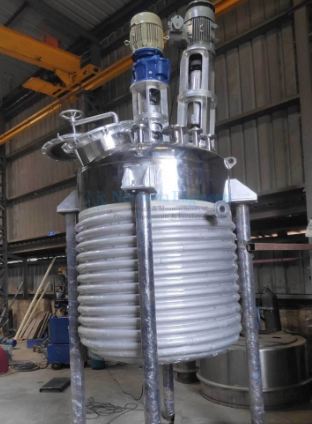 | Mixing Vessel Nes India Engineers are the most leading Manufacturers, Suppliers, Exporters of Mixing Vessel in India, Pune, Aurangabad, Goa, Chennai, Mumbai,... View product → |
Frequently asked questions
How do you choose between a mixing vessel and a storage tank for mineral chemicals?
Choose a mixing vessel when the process requires heat transfer, liquid blending, gas dispersion or solids suspension. Choose a storage tank when the material only needs containment without active processing.
What materials and pressure limits should you specify?
Specify the wetted material, lining, corrosion allowance, design temperature and design pressure for the worst batch, including cleaning and upset conditions.
How should you size a vessel and agitator for solids suspension?
Define particle size, density, concentration, liquid viscosity and target suspension, then size the vessel geometry, impeller and motor around those conditions.
What should you compare between mixing vessel manufacturers?
Compare fabrication drawings, nozzle schedules, agitator calculations, pressure and vacuum design, material certificates, inspection records, testing and maintenance documentation.