
A drum’s diameter and length do not tell you whether it can evaporate the water in your feed. You will be able to convert wet feed into dry-solids and evaporation rates, calculate the thermal and residence-time requirements, and compare supplier proposals on the same basis.
Key takeaways
- Calculate water removal from wet feed and inlet and outlet moisture fractions.
- Size heat duty and gas flow around product properties, not nominal drum volume.
- Use residence time tests to set drum diameter, length, slope and internals.
- Compare guarantees for evaporation, outlet moisture, fuel use and product quality.
Start With the Mass Balance, Not the Drum Dimensions
Calculate water removal on a wet basis: water removed = F × (Xf − Xp) ÷ (1 − Xp). F is wet feed rate, Xf is inlet moisture fraction and Xp is target outlet moisture fraction.
Rotary dryer size means the physical drum diameter and length; rotary dryer capacity means a throughput basis, not a dimension.
For 5 tonnes per hour of feed at 30% moisture, dry solids equal 5 × 0.70 = 3.5 tonnes per hour. At 10% final moisture, finished product equals 3.5 ÷ 0.90 = 3.889 tonnes per hour, so water evaporation equals 1.111 tonnes per hour.
A quotation stating “5 tonnes per hour” is incomplete unless it identifies the rate.
| Capacity basis | What it means | Comparison requirement |
|---|---|---|
| Wet-feed rate | Total incoming material, including water | State inlet moisture |
| Dry-solids rate | Moisture-free solids entering the dryer | State calculation basis |
| Water-evaporation rate | Water removed per hour | State inlet and outlet moisture |
| Finished-product rate | Dried material leaving the dryer | State target moisture |
Repeat the mass balance for:
- Minimum feed, normal feed and peak feed, using the highest credible inlet moisture.
- Startup losses, recycle material and planned expansion as separate cases.
- Each supplier’s stated basis, so you do not compare wet-feed tonnes per hour with another supplier’s dry-solids or evaporation rating.
Match Heat Duty, Gas Flow and Airflow Arrangement to the Product
Two dryers handling the same wet-feed rate can need different dimensions because thermal duty and gas volume impose separate limits. Calculate duty as water latent heat plus sensible heating of the wet feed, dry product and drying gas, then add shell and duct losses and divide by burner or hot-air-generator efficiency.
Cold feed and high exhaust temperature both increase fuel demand; evaporation is not the whole duty.
1. Set inlet and outlet gas temperatures around the product’s maximum permitted temperature. Include available fuel, combustion-air temperature, allowable exhaust temperature and oxygen limit before rotary dryer capacity selection.
2. Calculate gas volume from the duty and temperature rise, then size the fan, ducts, cyclone and bag filter for that volume and dust loading. Excessive velocity entrains fines, raises pressure drop and carries wet particles into the exhaust system.
3. Choose airflow and heating arrangement against product risk. Direct heating suits clean, gas-compatible solids; indirect heating separates combustion gas but adds heat-transfer surfaces and maintenance. For heat-sensitive or combustible feed, use lower product temperature, cocurrent flow or indirect heating when proven; counter-current flow dries more strongly but puts driest solids nearest the hottest gas.
4. Compare rotary dryer options for site consequences. Single-pass drums simplify cleaning; multi-pass designs reduce footprint but add transfer points. Combustible dust or solvent vapour can require inerting, explosion relief, isolation, grounding and solvent monitoring before fan and duct sizing.
| Option | Main benefit | Main penalty |
|---|---|---|
| Cocurrent | Protects wet feed from early overheating | Weaker final drying |
| Counter-current | Stronger final drying force | Hottest gas meets driest solids |
| Direct | Compact heat transfer | Product contacts combustion gas |
| Indirect | Separates gas from product | More surfaces and maintenance |
Use Residence Time and Material Behaviour to Set Drum Geometry
Start with the residence time required to reach target moisture, then match it to usable hold-up and solids flow. A useful check is residence time = material hold-up ÷ volumetric solids flow; drum length alone cannot establish it.
- Estimate drying time from moisture reduction, particle-size distribution, bulk density, feed temperature and drying kinetics. Include the effect of cocurrent or countercurrent gas flow.
- Check drum diameter against gas velocity and volumetric loading. Low-density powder occupies more volume at the same tonnes per hour, while excessive velocity increases dust carryover.
- Set usable hold-up near the operating range of 8–15% of drum volume. Filling the shell like a mixer reduces gas–solid contact; too little material makes feed fluctuations more disruptive.
- Check length only after selecting slope, rotational speed and gas flow. These variables, together with angle of repose, determine solids movement and discharge.
- Specify flights by lifting pattern, height and spacing. The curtain they create controls heat transfer; poor flighting causes dead zones, wall buildup, uneven moisture or excessive fines.
Material behaviour determines the internal design. Sticky feed needs anti-buildup flighting, suitable liners or different rotary dryer options; abrasive feed needs wear-resistant liners and replaceable flights. Uniform feeding matters because a sudden wet pocket can leave under-dried product even when the average moisture balance looks correct.
Recheck diameter, length, speed, slope, flights and airflow together before approving the rotary dryer size.
Compare Supplier Proposals on a Shared Guarantee Basis
What you give a rotary dryer manufacturer size for selection is the operating envelope, not a preferred drum diameter.
State hourly minimum, normal and maximum feed rate; wet- and dry-basis inlet moisture; target residual moisture; feed temperature; particle-size distribution; bulk density; stickiness; abrasiveness; allowable product temperature; inlet-air conditions; available fuel; operating hours; recycle rate; and allowable exhaust temperature.
Require every quotation to report these comparable outputs:
| Quotation field | Why it matters |
|---|---|
| Drum diameter and length | Defines physical rotary dryer size |
| Air volume and heat duty | Checks gas flow and thermal load |
| Residence time and evaporation rate | Tests drying performance |
| Specific energy consumption and fan power | Exposes operating cost and pressure drop |
| Dust-collection load and footprint | Defines utilities and site scope |
Separate nominal capacity from guaranteed capacity. The guarantee must state test moisture, feed temperature, particle-size range, bulk density, product temperature, inlet and outlet gas temperatures, operating hours, and whether capacity means wet feed, dry solids or water evaporation.
Ask for a mass-and-energy balance, plus pilot or material-test evidence for cohesive, friable, heat-sensitive or variable feeds. A residence-time trial before fabrication can expose dead zones, buildup and carryover.
| Capacity basis | Compare only against |
|---|---|
| Wet feed | Wet tonnes per hour at stated moisture |
| Dry solids | Solids tonnes per hour |
| Evaporation | Water removed per hour |
This shared basis makes rotary dryer capacity selection defensible. Nes India Engineers can help translate that envelope into drum geometry, flights, heating and documentation instead of quoting catalogue capacity alone.
Related product
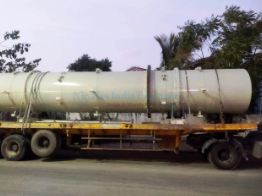 | Continuous Dryer A Rotary Dryer is a robust and highly efficient industrial drying system designed to reduce the moisture content of a wide range of bulk solids. View product → |
Decide Whether a Rotary Dryer Fits the Process and Site
Choose a rotary dryer for continuous bulk solids that tolerate tumbling and direct contact with a hot gas stream. Select another dryer when the feed form, product sensitivity or containment standard makes that contact unsuitable.
| Dryer | Choose it when | Rotary-dryer limitation |
|---|---|---|
| Fluid bed | Particles fluidise readily and need fast, uniform gas–solid contact | Tumbling is unnecessary |
| Spray dryer | A liquid or slurry must become powder | A rotary drum needs a solid feed |
| Spin flash | The feed is wet paste or filter cake | Sticky feed can build up on flights |
| Vacuum or atmospheric tray | The batch is small, solvent service applies or gentle shelf drying matters | Continuous bulk throughput is not the priority |
Reject a drum for severe contamination control, very fine powder specifications, tumbling-induced agglomeration or highly heat-sensitive material unless pilot testing proves acceptable drying, residence time and product quality. Test sticky, cohesive, friable or variable feed to establish buildup, flight pattern, outlet moisture and safe gas temperature.
Site work changes rotary dryer size and rotary dryer options. Include foundations, drum alignment, ducting, hot-air generation, cyclone or bag-filter integration, insulation, controls, commissioning and operator training in the layout.
Review combustible dust or solvent vapour before approving dimensions. Specify fire detection, explosion relief, isolation, burner interlocks, oxygen control, grounding, emergency shutdown and compatible dust collection; these alter fan duty, duct routing and gas composition.
For pharmaceutical service, add cleanable seals, sanitary surfaces, inspection doors and accessible internals. Apply the cleaning procedure required by 21 CFR 211.67. Define the feed envelope, calculate duty, verify residence time, test difficult materials, then approve the drum and options.
Frequently asked questions
How do you calculate the required rotary dryer capacity?
Start with the wet feed rate and moisture balance. Water removed equals F × (Xf − Xp) ÷ (1 − Xp), where F is wet feed rate, Xf is inlet moisture fraction and Xp is target outlet moisture fraction. Add the required operating margin after defining feed variability and availability.
How do heat duty and airflow affect rotary dryer size?
Heat duty depends on water evaporation, product heating, feed moisture, exhaust losses and heat losses through the shell. Gas flow must provide the required heat transfer without excessive product entrainment, thermal damage or unsafe dust concentrations. Select parallel-flow or counter-current airflow according to product temperature sensitivity and final moisture requirements.
How does residence time determine rotary dryer geometry?
Residence time depends on feed rate, drum diameter, length, slope, rotation speed, flights, fill level and material flow properties. Use pilot or plant test data to confirm how the product moves before fixing drum dimensions.
What should you compare in rotary dryer supplier proposals?
Request the same feed conditions, product specification and operating hours from every supplier. Compare guaranteed evaporation rate, outlet moisture, product temperature, fuel or energy consumption, exhaust volume, dust carryover, emissions equipment, installed power, materials of construction and required footprint.
When is a rotary dryer the wrong choice?
Choose another dryer when the product cannot tolerate prolonged heat exposure, tumbling, dust generation or contact with hot gas. Check fluid-bed, vacuum, spray, belt or paddle drying when lower temperature, shorter residence time or closed solvent recovery controls the process.