
The right answer depends on more than the dryer’s purchase price or its ability to operate under vacuum. By comparing the product, batch cycle, alternatives, safety requirements, validation burden, and total cost per kilogram, you can decide whether vacuum tray dryer equipment fits your plant before requesting quotations.
Key takeaways
- Choose vacuum drying when heat, oxygen, or solvent loss threatens product quality.
- Specify vacuum level, shelf temperature, load depth, cycle time, and vapour handling.
- Compare throughput and labour against alternative dryers using validated cost per kilogram.
- Request cleaning, containment, documentation, and testing details before comparing quotations.
When vacuum drying creates enough value to justify the equipment
It earns its keep when a product cannot tolerate atmospheric drying, yet must be processed in batches. The question is not whether a vacuum tray dryer worth it in theory; compare its validated drying time and total cost per kilogram with the quality loss, solvent controls, and longer cycle of alternatives.
| Product or condition | Why vacuum adds value | When to reject it |
|---|---|---|
| Heat-sensitive powders, wet cakes, granules, and pharmaceutical intermediates | Reduced pressure lowers the boiling point, limiting product temperature while heated shelves supply controlled heat | Reject it if testing shows the material dries quickly without heat damage in a fluid bed or atmospheric tray |
| Solvent-bearing or oxidation-prone chemicals | A sealed chamber, condenser, vacuum system, and inert-gas purge reduce solvent exposure and oxygen contact | Reject it if solvent recovery, oxygen limits, or unloading controls cannot be validated |
| Contained, high-value batches with variable recipes | Closed batch handling supports segregation, cleaning, and recipe-specific cycles | Reject it if labour-intensive loading and unloading outweigh containment benefits |
| Large volumes of robust, free-flowing material | Little economic advantage over a continuous or fluid-bed process | Reject it when throughput, automation, or low cost per kilogram is the plant’s main constraint |
Buy only when the batch format fits your production schedule and the supplier can prove the named product’s loading depth, tray area, initial and final moisture, shelf temperature, drying time, and capacity. Require chamber temperature mapping, shelf control, vacuum-hold testing, condenser performance, and product results under defined conditions. A lower pressure reading alone proves nothing.
How pressure, shelves, and vapour removal determine drying performance
At 20 kPa absolute, water boils at about 60 °C; at 6.3 kPa, it boils at about 37 °C. In vacuum tray dryer equipment, that pressure change lowers the temperature needed for evaporation, but it does not set the product temperature. Heat input and vapour removal determine the result.
The actual product temperature comes from three interacting controls:
- Shelf heat transfer: Heated shelves conduct energy through the tray and product bed. Poor tray contact or high thermal resistance slows drying even when the shelf sensor shows the correct temperature.
- Bed thickness: A shallow, even layer dries more uniformly. A deep bed can form a dry surface over a wet core, increasing cycle time and edge-to-centre variation.
- Vapour removal: The condenser and vacuum system must remove vapour at the peak evaporation rate. If they cannot, pressure rises, boiling slows, and solvent can reach the pump or exhaust.
During active evaporation, latent heat can keep the product well below shelf temperature. As free moisture or solvent is depleted, evaporative cooling weakens and the product temperature rises; an aggressive shelf setting can then overheat a dry surface while the core remains wet.
Size the condenser and vacuum system for the product’s vapour load, solvent composition, condensing temperature, and non-condensable leakage. Ask for a test showing shelf-temperature distribution, vacuum hold, condenser capture, and final product moisture under defined loading conditions.
Which dryer fits your material, throughput, and labour model
Choose by the bottleneck you must remove: heat exposure, oxygen exposure, throughput, or operator time. A vacuum tray dryer fits controlled batches; it is rarely the best answer for a continuous, high-volume line.
| Option | Material and process fit | Throughput and labour model |
|---|---|---|
| Vacuum tray | Heat-sensitive, oxidation-sensitive, solvent-bearing powders, wet cakes, and intermediates | Batch operation with loading, unloading, and cleaning; slower, but offers containment and gentle drying |
| Atmospheric tray | Robust solids that tolerate air and higher temperatures | Lowest process complexity, but long cycles and greater manual handling |
| Fluid bed | Free-flowing particles that tolerate fluidisation | High heat and mass transfer with good automation; unsuitable for sticky cakes or materials that do not fluidise |
| Rotary | Robust granules, crystals, and bulk solids needing continuous movement | Continuous, high-throughput production; more mechanical handling and attrition |
| Spray | Liquids, solutions, and pumpable slurries converted directly to powder | Very high throughput and automation; requires atomisation and produces a defined powder morphology |
| Spin flash | Cohesive wet cakes, pastes, and slurries needing rapid dispersion | Continuous drying with strong mechanical shear; unsuitable for fragile particles or products that must retain structure |
Do not compare nominal chamber volume with a fluid-bed or spray-dryer rate. Compare kilograms of named product per validated cycle, including loading, drying, cooling, unloading, and cleaning.
For a vacuum tray dryer, verify usable tray area, product depth, bulk density, moisture targets, and cycle time. If operators are your constraint, a faster dryer with automated feeding may beat a gentler batch system even when its purchase price is higher.
What to specify before asking a vacuum tray dryer manufacturer for a quotation
The information you send a vacuum tray dryer manufacturer for buying decision must describe the product and the finished cycle, not just the batch size. Otherwise, a chamber-volume quotation can hide inadequate tray area, excessive product depth, and an unrealistic drying time.
- Name the product, solvent, initial and final moisture, batch mass, bulk density, allowable product temperature, loading depth, target cycle time, cooling requirement, and cleaning method.
- Request tray area, tray dimensions and material, shelf temperature range and uniformity, chamber design pressure, vacuum-pump capacity, condenser temperature and solvent capacity, insulation, seals, valves, instrumentation, and control-system functions.
- Define the evacuation and inert-gas-purge sequence, maximum oxygen concentration, allowable leak rate, backfill-gas quality, unloading exposure, solvent handling, relief protection, interlocks, and electrical classification.
- Price vacuum-pump electricity, chilled-water or condenser duty, nitrogen use, solvent recovery or disposal, loading labour, cleaning, tray handling, validation, spares, and downtime—not only the dryer.
| Area | Supplier must specify | Supplier must prove |
|---|---|---|
| Process performance | Named product, loading depth, moisture targets and cycle time | Drying uniformity, final moisture and product temperature |
| Qualification | Temperature mapping, shelf control and calibrated sensors | Chamber distribution, shelf stability and instrument accuracy |
| Vacuum system | Hold-test method, leak-rate limit and condenser duty | Vacuum hold, leak test and vapour-condensing performance |
| Safety | Oxygen alarm, inerting logic and pressure protection | Interlock operation and safe fault response |
Ask Nes India Engineers for these acceptance tests in the quotation, because a vacuum tray dryer manufacturer that prices equipment without measurable proof leaves you carrying the performance risk. In pharmaceutical service, document process design, process qualification, and continued process verification.
Related product
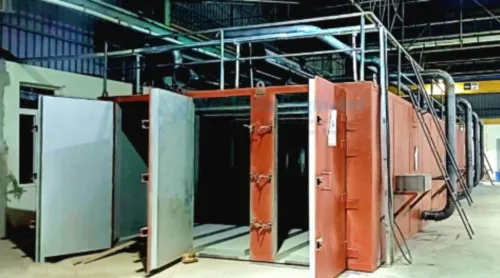
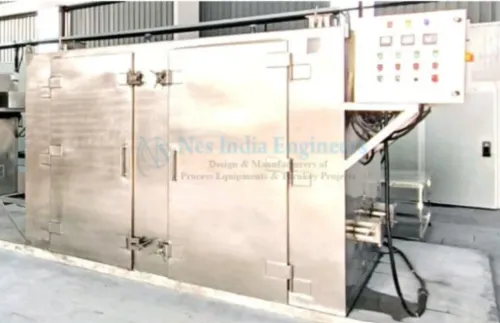
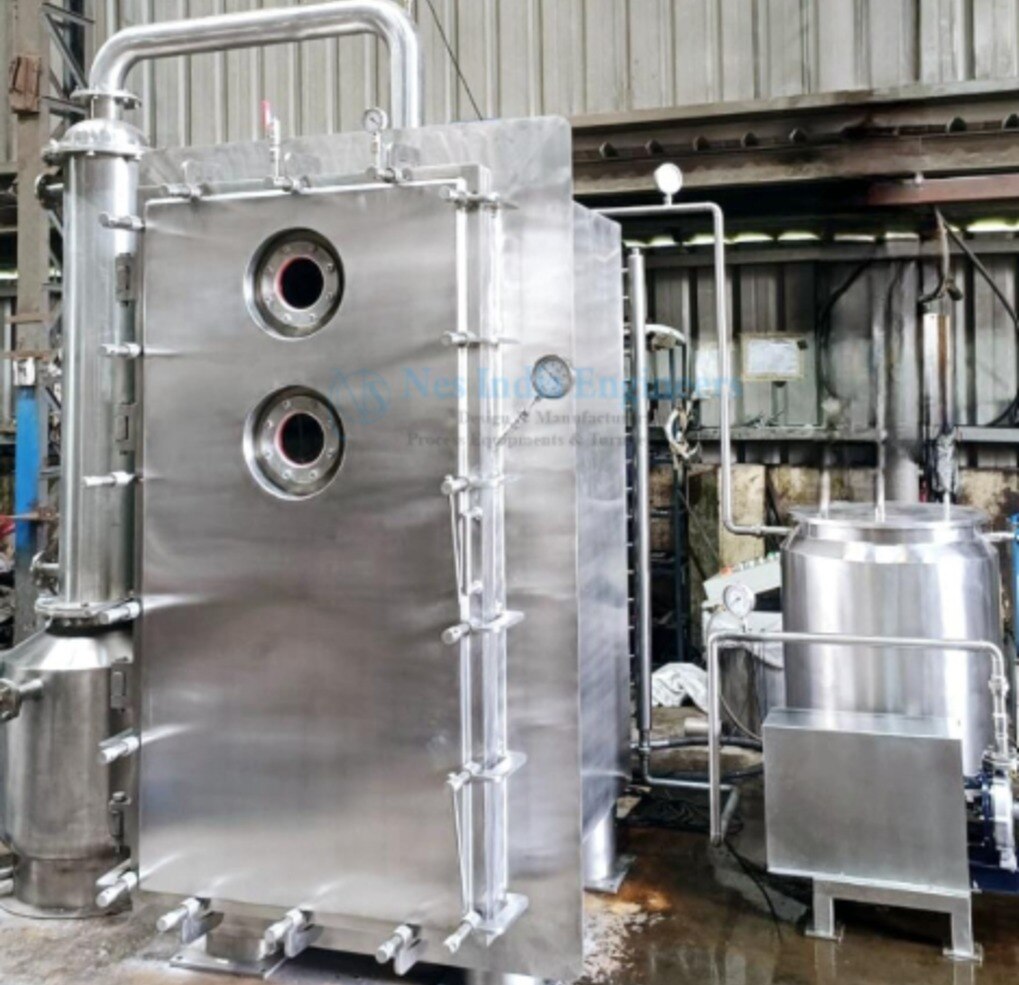
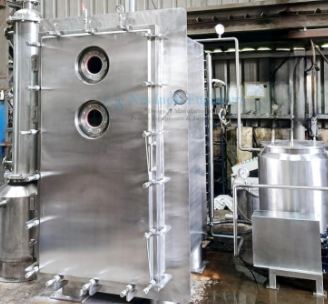 | Batch Dryers We Ness India Engineers from Pune, Maharshtra, India are a leading manufacturer, supplier and exporter of vacuum tray dryer in India. View product → |
The real purchase test: capacity, compliance, and cost per kilogram
Use cost per saleable kilogram, not the quotation price, as the buying test. Divide annualized capital cost plus annual operating cost by validated annual output. Include installation, utilities, maintenance, validation, and financing or depreciation in the capital figure; use actual saleable kilograms after rejected batches and downtime.
Build the annual operating estimate from these inputs:
- Vacuum-pump electricity and maintenance
- Shelf-heating energy, condenser duty, and chilled-water consumption
- Nitrogen or other inert-gas consumption
- Solvent recovery, disposal, and emissions-control charges
- Loading, tray handling, unloading, cleaning, and changeover labour
- Planned downtime, failed batches, spare parts, and requalification
Then compare that figure with the validated cost per kilogram from the current dryer or a continuous alternative. A batch dryer is difficult to defend when loading, drying, cooling, and unloading leave too little productive time for the required annual volume.
Capacity must use tray area, allowable product depth, bulk density, initial and final moisture, shelf temperature, and validated cycle time. A nominal chamber volume proves little; a deep bed can retain a wet core and reduce saleable output.
Compliance adds value only when it is demonstrated. Require records for cleaning and process validation, plus the evacuation and inert-gas-purge sequence, oxygen limit, backfill-gas quality, unloading exposure, and a leak test stating starting pressure, isolation time, temperature, pressure rise, and included piping. That evidence decides whether buying a vacuum tray dryer is worth it.
Frequently asked questions
When is a vacuum tray dryer worth buying?
It is worth considering when your product cannot tolerate atmospheric drying and batch processing remains practical. Compare validated drying time and total cost per kilogram with quality loss, solvent controls, and alternative dryer cycles.
How do pressure, shelves, and vapour removal affect drying performance?
Pressure sets the boiling conditions, heated shelves transfer energy to the trays, and vapour removal keeps evaporation moving. Evaluate all three together rather than comparing vacuum level alone.
Which dryer should you choose for your material and throughput?
Choose based on heat sensitivity, solvent content, batch size, target moisture, containment needs, cycle time, and available labour. A vacuum tray dryer suits controlled batch production, while continuous or agitated dryers can fit higher-throughput operations.
What should you specify before requesting a quotation?
Provide material properties, batch mass, initial and final moisture, solvent details, allowable product temperature, tray dimensions, vacuum target, cycle time, cleaning method, containment requirements, utilities, and documentation needs.