
A ribbon blender can deliver a uniform dry blend, but its suitability depends on powder behaviour, batch size, humidity control, discharge design and cleaning access—not on vessel capacity alone. By the end, you will be able to compare it with other batch blenders, identify failure risks and write a qualification brief for your Bengaluru facility.
Key takeaways
- Choose ribbon blenders for free-flowing, robust powders needing low-to-moderate shear.
- Match working volume to batch size, fill ratio, and Bengaluru operating conditions.
- Prove blend uniformity with sampling plans that avoid segregation during discharge.
- Demand cleanable surfaces, controlled containment, documented testing, and pharmaceutical references.
Which pharmaceutical powders suit a ribbon blender?
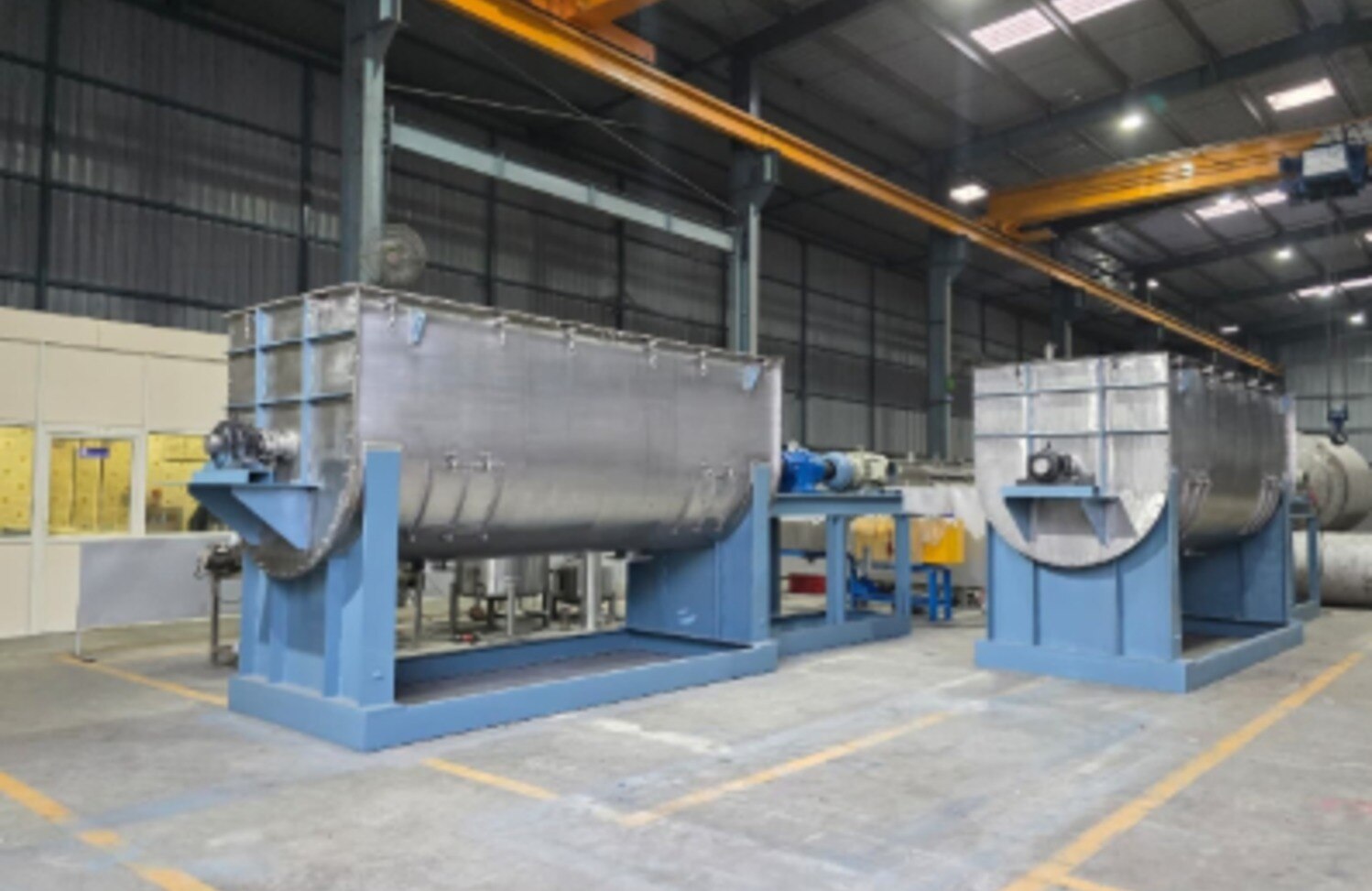
A ribbon blender for pharmaceutical manufacturers is a sensible first choice for a free-flowing, robust dry blend that needs low-to-moderate shear—not automatically for every API or excipient. Inner and outer helical ribbons move powder in opposing axial directions while lifting it radially, creating counter-current circulation through the vessel.
| Blender | Operating principle | Better fit |
|---|---|---|
| Ribbon | Counter-current axial movement from inner and outer ribbons | Free-flowing excipient premixes, robust API blends, and lubricant-containing formulations that tolerate controlled shear |
| Octagonal | Vessel rotation tumbles the batch through repeated lifting and falling | Gentle mixing of free-flowing powders or granules when particle damage and shear must stay low |
| Double-cone | A rotating two-cone vessel repeatedly divides and recombines the powder | Small or moderate batches needing gentle handling and simple, low-shear movement |
Select the machine by working volume, not total vessel volume. Underfilling can prevent reliable circulation; overfilling reduces turnover and extends blend time, so qualify minimum, nominal, and maximum batch sizes.
Choose an octagonal or double-cone blender instead when fragile particles, narrow processing windows, or low-shear tumbling matter more than fast turnover. A ribbon blender is a weaker choice for highly cohesive, strongly agglomerated, heat-sensitive, or electrostatic powders unless validated conditioning or deagglomeration is built in.
Do not confuse the blender with a pharmaceutical storage tank. A closed, jacketed ribbon vessel can provide short-term hold, but the formulation must pass a hold study for moisture uptake, caking, segregation, microbial risk where relevant, and first-to-last discharge variation.
In Bengaluru, assess monsoon humidity and define exposure limits; hygroscopic powders may need dehumidified transfer or dry-air blanketing.
How do batch size and Bengaluru conditions change the decision?
Select the working volume from the validated fill range, not the vessel’s advertised capacity. A low fill can weaken circulation; an overfilled vessel reduces turnover and makes blend time unpredictable.
1. Define minimum, nominal, and maximum batch sizes before choosing the machine. Ask for test data at each load using your actual powder, because a supplier’s total-volume figure does not prove uniform mixing. Record the blend time and discharge recovery for every batch size.
2. Set the endpoint with formulation-representative trials. A longer run does not repair poor loading, and it can increase heating, particle damage, or segregation. Measure powder temperature during the run, not only the jacket temperature.
3. Treat Bengaluru humidity and monsoon exposure as process variables. Hygroscopic powders may need a dehumidified room, closed transfer, defined maximum exposure times, and dry-air or nitrogen blanketing where justified. A jacketed vessel needs temperature mapping under load, heat-transfer calculations, and condensation checks.
4. Use a closed ribbon blender for a short hold only when hold-time trials show no caking, moisture uptake, microbial risk where relevant, or first-to-last discharge variation. Confirm sealing, cleanability, recovery, and protection against segregation during discharge.
That is the practical limit of ribbon blender for pharmaceutical storage tank suitability in Bengaluru: it can blend and briefly hold, but it is not a primary storage tank. Assess ribbon blender suitability in Bengaluru against the full batch-to-pack sequence, not mixer capacity alone.
How do you prove uniformity without creating segregation?
Uniformity is proven with a formulation-specific endpoint and a sampling plan that follows powder out of the vessel. Extra blending is not proof; it can increase heat, particle damage and segregation.
- Define the endpoint using blend assay results, content-uniformity risk and a predefined acceptance criterion. Establish the shortest time that meets it, then confirm it across repeated representative batches rather than accepting a fixed mixing time.
- Sample locations that can reveal stratification: multiple vessel positions, different depths, early discharge, middle discharge and samples near the end. Include the transfer line or receiving container when conveying could separate coarse and fine particles; convenient top-surface samples cannot approve a batch.
- Map the process at the endpoint and during discharge. Check powder temperature, motor load, discharge time and first-to-last assay variation. For a ribbon blender for pharmaceutical manufacturers, request heat-transfer-area calculations, loaded temperature mapping and control-loop performance, including condensation protection during humid Bengaluru conditions.
- Stop overmixing when the endpoint is reached. Use grounded equipment, controlled humidity and an antistatic strategy for charged powders; excessive friction can warm the blend and make fines cling to surfaces.
- Protect fragile particles with the lowest effective speed and transfer energy. Use a controlled, short-drop discharge and validate the conveying route, because demixing can begin after the blender passes its uniformity test.
A jacketed vessel can provide a short hold, not automatic storage-tank suitability. Demonstrate hold-time recovery, moisture uptake, caking, segregation, cleanability and first-to-last discharge results before holding a finished blend before packing.
What hygienic and containment features are essential?
Cleaning validation can disqualify a ribbon blender before mixing performance does. Specify product-contact stainless steel, continuous ground-flush welds, no ledges or uninspectable dead zones, drainable geometry, and access to inspect ribbon flights, end plates, shaft interfaces and the discharge valve.
Demand these hygienic details in the equipment specification:
- Product-contact surfaces with a defined finish, commonly Ra ≤0.8 μm where the formulation and validation require it
- Shaft seals that prevent powder escape without creating a crevice around the product zone
- Sealed bearings outside the product-contact area, with no lubricant path into the batch
- Removable or inspectable seals, covers and spray-shadowed areas
- A discharge arrangement that empties without a retained heel
For high-potency, sensitising or cytotoxic powders, pair the blender with contained charging and discharge, negative-pressure connections, and safe-change filters or bags. Treat “closed” as a design claim, not containment evidence; require operator-exposure or containment-test data.
Bengaluru’s monsoon humidity also makes dehumidified transfer, dry-air or nitrogen blanketing, and defined maximum exposure time worth specifying for hygroscopic products.
Combustible organic powders require a dust-hazard assessment, bonding and grounding, ignition-source control, and pressure relief or suppression where required. Electrical components must match the site’s hazardous-area classification.
Validate changeover on the hardest-to-clean, hardest-to-contain product family using visual inspection plus swab or rinse recovery, with documented acceptance limits. A generic wash-time statement proves little.
What should you demand from a pharmaceutical powder blender supplier?
A pharmaceutical powder blender supplier must prove process performance, not just deliver a polished empty-machine demonstration. Require a formulation-representative FAT using your powder, or a documented surrogate with matching particle size, density, moisture and flow behaviour.
| Stage | Demand | Failure exposed |
|---|---|---|
| FAT | Capacity range, blend-uniformity protocol, discharge recovery, dust-tightness, seal leakage, noise, vibration and calibrated instruments | A machine that runs smoothly but produces non-uniform or unrecoverable batches |
| SAT | Repeat the approved checks after installation, including utilities, controls, interlocks, earthing and actual site conditions | Installation damage, incorrect rotation, calibration drift or inadequate extraction |
| Documentation | Drawings, materials, surface finish, weld records, manuals, calibration certificates, cleaning-access photographs and spare-seal details | Gaps that obstruct qualification, maintenance or cleaning validation |
- Demand temperature mapping under representative load if the vessel has a jacket. Heat-transfer-area calculations and control-loop records must show that the powder, not merely the jacket, reaches the required temperature without condensation in Bengaluru’s humid conditions.
- Inspect ribbon flights, shaft interfaces, end plates, seals and the discharge valve with the product family. A generic wash-time claim does not prove recovery from shadowed or difficult-to-access areas.
- If the vessel will hold finished blend, treat ribbon blender for pharmaceutical storage tank suitability in bengaluru as a hold-time question: require evidence on moisture uptake, caking, segregation, microbial risk where relevant and first-to-last discharge variation.
- For combustible organic powders, require dust-hazard assessment, bonding and grounding, ignition-source controls and site-compatible relief or suppression.
Nes India Engineers belongs on the comparison list only after it supplies this evidence against your batch and acceptance criteria.
Related product
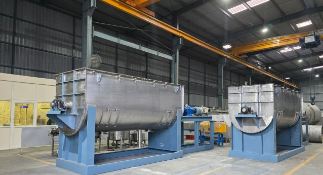 | Blenders NES India Engineers are the most leading Manufacturers, Suppliers, Exporters of Ribbon blenders in India, Pune, Aurangabad, Goa, Chennai, Mumbai,... View product → |
Frequently asked questions
Which pharmaceutical powders suit a ribbon blender?
Ribbon blenders suit free-flowing, robust powders that need low-to-moderate shear. They are a poor fit for fragile particles, highly cohesive powders, or products requiring intensive deagglomeration.
How do batch size and Bengaluru conditions change the decision?
Compare the smallest and largest batch with the blender’s working-volume range, fill ratio, motor load, and discharge behaviour. In Bengaluru, assess room humidity, temperature control, dust extraction, and material moisture sensitivity.
How do you prove uniformity without creating segregation?
Use a documented sampling plan covering multiple vessel locations and discharge stages, then test assay or content uniformity against predefined acceptance criteria. Control transfer height, vibration, and discharge time to limit segregation.
What hygienic and containment features are essential?
Specify polished product-contact surfaces, hygienic welds, drainable geometry, validated cleaning access, a sealed shaft arrangement, suitable gaskets, dust-tight charging, and contained discharge.
What should you demand from a pharmaceutical powder blender supplier?
Request a design qualification package, material certificates, surface-finish records, drawings, motor data, cleaning guidance, factory acceptance testing, site acceptance testing, and documented powder trials.