
The right dryer depends on solvent boiling point, degradation temperature, target moisture, batch form and the plant’s ability to handle heat and vapour. By comparing those factors with Bengaluru’s humidity, utilities, safety controls and pharmaceutical documentation needs, you can build a defensible equipment specification instead of choosing from a machine name alone.
Key takeaways
- Choose atmospheric drying for heat-stable solids that tolerate oxidation and longer cycles.
- Choose vacuum drying for heat-sensitive, oxidation-prone products or lower solvent-boiling temperatures.
- Test moisture removal, endpoint, solvent recovery and cycle time before selecting equipment.
- Verify tank material, finish, pressure rating, cleaning records and pharmaceutical licences before purchase.
Which products suit atmospheric drying, and which need vacuum?
Choose atmospheric tray drying when the solid tolerates heated air, does not oxidise during prolonged exposure, and can accept a longer batch. It suits plants where simple equipment, easy operator loading and unloading, and lower capital cost matter more than the shortest cycle.
| Option | Heat and vapour movement | Best fit and trade-offs |
|---|---|---|
| Atmospheric tray dryer | Forced air transfers heat; exhaust air carries away moisture. Hot air commonly operates at 60–120 °C, depending on the product. | Heat-tolerant solids and water-based batches. Cycles are longer, final moisture depends on ambient humidity, and monsoon air in Bengaluru can extend drying. |
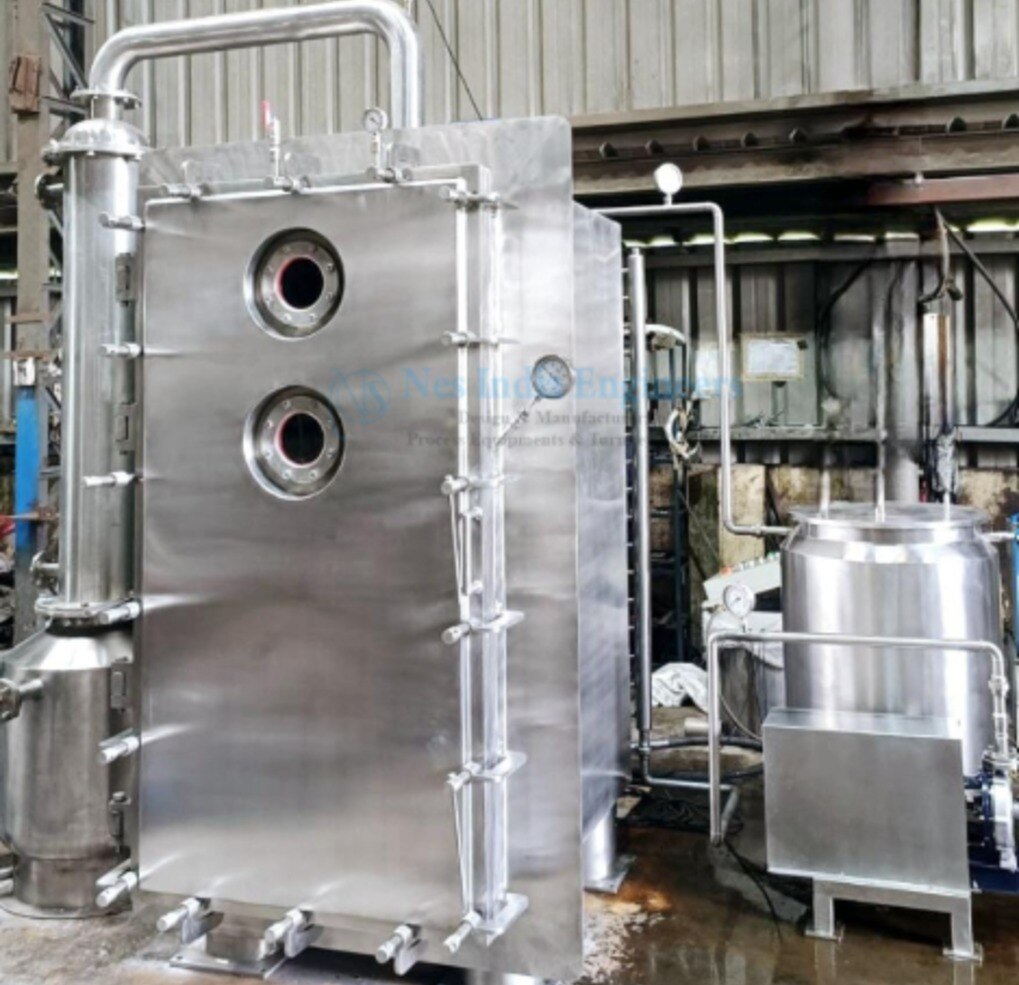
| Vacuum tray dryer | Heated shelves conduct heat into a static bed while reduced pressure removes vapour. Water boils at about 60 °C at 20 kPa absolute, 46 °C at 10 kPa, and 33 °C at 5 kPa. | Heat-sensitive, oxidation-sensitive, or solvent-containing solids requiring contained vapour handling and lower boiling temperatures. |
Vacuum is not automatically low-temperature. Product temperature also depends on shelf temperature, cake thickness, gas load, solvent composition, leaks, and diffusion limits; a deep vacuum rating alone proves little. Compare residual moisture or loss on drying, residual solvent, energy per batch, operator hours, cleaning time, and installed cost—not nominal capacity alone.
For a vacuum tray dryer for chemical plants in bengaluru, confirm that the product actually reaches the pressure and temperature profile required for its endpoint.
How should you develop the drying process before choosing equipment?
Convert the product into a measurable process specification before choosing a dryer. Start by recording:
- Physical form: wet-cake, powder, granule, crystal, paste or filter-cake
- Wet-basis moisture and bulk density
- Particle-size distribution
- Solvent composition
- Degradation temperature
- Target moisture or loss on drying
- Residual-solvent limit
- Maximum residence time
Set tray loading depth and spreading thickness during development. A thick bed slows heat penetration, encourages crust formation and leaves a harder cake to unload; an uneven or thin spread increases exposed surface, agglomeration risk and tray-to-tray variation.
Run trials at several shelf temperatures and absolute pressures. Measure product temperature, pressure profile, cycle time, final moisture, residual solvent, assay and degradation products.
| Process factor | Atmospheric drying | Vacuum drying |
|---|---|---|
| Heat and vapour movement | Air-change rate, inlet-air temperature and humidity, exhaust moisture removal | Shelf heat-transfer rate, vapour path, condenser capacity and pump performance |
| Scale-up risk | Air distribution changes with loading | Adding trays does not guarantee proportional scale-up because shelf contact, vapour paths and tray-to-tray locations change |
| Main checks | Inlet condition and exhaust capacity | Leak tightness, condenser loading and pump recovery |
Define the endpoint before comparing vacuum drying equipment in Bengaluru: final moisture or loss on drying, residual solvent, assay, degradation-product limits, cycle time and energy per batch. Require a leak test, vacuum recovery time and repeatability across tray positions. Without those acceptance criteria, a deeper advertised vacuum proves little.
What changes when Bengaluru humidity, water and solvents enter the design?
Bengaluru’s monsoon humidity changes the dryer specification, not just the cycle time. Atmospheric drying takes in wetter air, increasing moisture in the exhaust; the batch can run longer or fail to reach the final moisture achieved in drier weather. A purchase-price comparison that ignores this load is incomplete.
1. Request atmospheric-dryer performance at the intended seasonal inlet condition, including inlet-air temperature and humidity, cycle time and final moisture. Check whether dehumidification, filtration, greater exhaust capacity or air-balance controls are needed.
2. For water drying under vacuum, size the condenser and receiver from evaporation rate, cooling-water temperature and available flow. Verify chilled-water demand when cooling water cannot condense vapour at the required pressure; an undersized condenser raises pressure and slows drying.
3. For organic solvents, size the condenser, receiver and vapour line from solvent mass and vapour-generation rate, not chamber volume. Specify liquid-carryover protection for the vacuum pump, solvent-compatible seals, vapour recovery and emissions control. Add ignition prevention, hazardous-area classification, oxygen monitoring and nitrogen inerting when the risk assessment requires them.
4. Confirm electrical load, standby power for vacuum and cooling systems, exhaust routing and safe discharge before selecting chemical drying equipment near Bengaluru. These utilities and safeguards can cost more than the dryer cabinet, while a leak, cooling failure or power interruption can spoil a batch or release flammable vapour.
What must pharmaceutical buyers verify, especially when a storage tank is mentioned?
Do not approve a vessel from its name alone. A vacuum tray dryer is a sealed drying chamber with heated shelves, trays, vapour removal, vacuum-break controls and product discharge; a storage tank normally holds, mixes or transfers liquid. A tank is not a dryer: nominal tank thickness plus a vacuum-pump connection does not prove suitability.
| Equipment | Normal function | Evidence expected |
|---|---|---|
| Storage tank | Holds, mixes or transfers liquid | Agitation, transfer and pressure data |
| Vacuum tray dryer | Dries a solid bed under controlled vacuum | Shelves, vapour path, seal, discharge and cycle controls |
For a pharmaceutical storage tank vacuum tray dryer for comparison in Bengaluru, require the process design document, product-contact material, pressure rating and written pharmaceutical acceptance criteria. Verify external-pressure design calculations, chamber finish, internal supports, door seal, heating surface, inspection access, drainability, leak-test method and solvent-vapour compatibility.
Also compare:
- Gasket material, dead zones and cleanability.
- Cleaning-validation sampling, containment and cross-contamination controls.
- Batch-record fields for tray load, shelf temperatures, absolute pressure, vacuum-break gas, cycle endpoint, moisture and residual solvent against applicable ICH Q3C limits.
Apply 21 CFR 211.63 where equipment design, size and location affect drug quality, and 21 CFR 211.67 where cleaning and maintenance requirements apply. At this specification stage, ask Nes India Engineers to separate a storage-vessel quote from a vacuum-tray-dryer design review and provide the calculations, drawings and test documents needed for Bengaluru operating conditions.
Related products
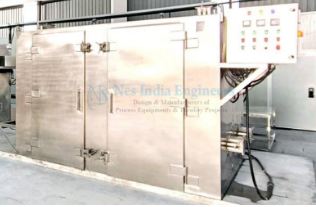 | Batch Dryers Nes India Engineers are the most leading Manufacturers, Suppliers, Exporters of Atmospheric Tray Dryers in India, Pune, Aurangabad, Goa, Chennai,... View product → |
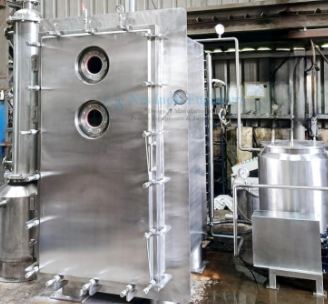 | Batch Dryers We Ness India Engineers from Pune, Maharshtra, India are a leading manufacturer, supplier and exporter of vacuum tray dryer in India. View product → |
How can you compare the two options on a like-for-like basis?
Use one comparison sheet for the same product, batch size and endpoint; nominal dryer capacity is not a fair basis. Record these values from a representative full-load trial:
| Measure | Atmospheric drying | Vacuum tray drying |
|---|---|---|
| Product and load | Form; wet and dry batch mass; bulk density; tray area; loading depth | Same measurements |
| Process | Shelf or air temperature; absolute pressure; heating medium; air or vapour flow; cycle time | Same measurements |
| Result | Final moisture or loss on drying; residual solvent; energy per batch; solvent recovered | Same measurements |
| Work and losses | Operator hours; cleaning and changeover time; leak-test result; unloading losses | Same measurements |
| Capital train | Filtration, heater, fan, dehumidification and exhaust | Vacuum pump, condenser, receiver, vapour-line protection, cooling or chilled water, nitrogen, controls and hazardous-area equipment |
Choose atmospheric drying when the material tolerates heat and oxygen, water is the solvent, seasonal humidity is manageable, and simpler operation outweighs longer residence time. Choose vacuum when low boiling temperature, oxygen reduction or contained solvent recovery is essential, and the plant can maintain seals, condensation and inerting.
Require a representative product trial and a documented acceptance test before approving a quote. Set acceptance limits for final moisture, residual solvent, assay or degradation, cycle time, energy, recovery, cleaning time and unloading loss at full tray load.
The reliable Bengaluru choice is the system that repeatedly meets quality and safety limits—not the lowest purchase price or deepest advertised vacuum.
Frequently asked questions
Which products suit atmospheric drying, and which need vacuum?
Use atmospheric drying for heat-stable solids that tolerate heated air, oxidation and longer batch times. Use vacuum drying for heat-sensitive or oxidation-prone products and materials that need solvent removal at lower temperatures.
How should you develop the drying process before choosing equipment?
Measure initial moisture or solvent content, target endpoint, product temperature, drying time, load depth and heat-transfer conditions. Run trials before fixing tray area, vacuum capacity, condenser duty or batch size.
What changes when Bengaluru humidity, water and solvents enter the design?
Account for humid intake air, wet-season drying performance, utility-water quality and solvent vapour handling. Specify dehumidification, closed solvent recovery, condenser capacity, ventilation and hazardous-area controls where the process requires them.
What must pharmaceutical buyers verify when a storage tank is mentioned?
Confirm whether the tank is product-contact equipment or only a utility vessel. Check material grade, internal finish, weld quality, pressure or vacuum rating, agitator design, drainability, cleanability, inspection records and the supplier's licence documents.
How can you compare vacuum and atmospheric drying on a like-for-like basis?
Compare equal dry-product batch sizes using cycle time, yield, endpoint moisture, energy, labour, solvent recovery, cleaning time, maintenance and total installed cost. Include utilities and validation effort rather than comparing purchase prices alone.