
A failed batch, contamination event, cooling failure or specification change does not always mean scrapping the material, but recovery depends on chemistry, heat removal, mixing and safe discharge—not vessel volume alone. You will be able to choose a recovery route, test whether it is safe, and specify reactor process equipment that can handle both normal campaigns and upset conditions.
Key takeaways
- Quarantine failed batches and preserve samples before changing process conditions.
- Match recovery chemistry to the failure mode, not the original batch recipe.
- Size for usable volume, heat removal, mixing duty and safe headspace.
- Compare materials, safeguards, controls, testing and service—not vessel price alone.
Start with a controlled recovery decision, not a rushed rework batch
Do not put a failed batch straight back into a specialty chemical reactor. Quarantine the material, stop transfers, preserve samples, and open a deviation record before anyone changes temperature, pH, solvent ratio, or agitation.
Recovery is justified only when the failure is understood, the material remains chemically safe, and the corrected route can meet the product specification.
- Identify the failure mode: incomplete conversion, contamination, wrong concentration, overheating, excessive solids, equipment interruption, or an out-of-specification impurity.
- Check the batch history, raw-material identity, analytical results, maximum temperature reached, hold time, pressure excursions, and exposure to air or moisture.
- Run a laboratory or pilot trial using a representative sample. Measure reaction heat, gas evolution, viscosity, solids formation, mixing behaviour, and the final impurity profile.
- Define the corrected recipe, addition order, temperature limits, sampling points, and emergency stop criteria before restarting.
- Release the recovered material only after documented quality-control testing confirms identity, assay, impurities, moisture, colour, and other specified attributes.
The reactor must also support the proposed correction, not merely hold the batch. Confirm usable working volume, heat-removal capacity, agitator torque, condenser and vacuum capacity, drainability, and pressure protection at the revised conditions.
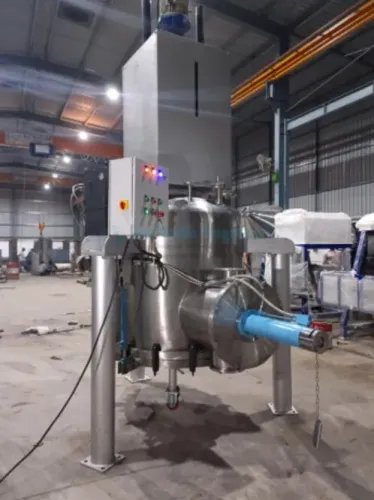
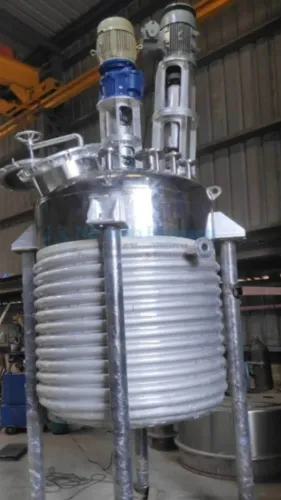
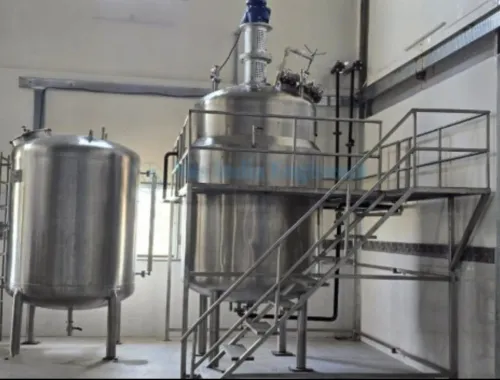
A chemical production reactor that handles the normal recipe can become unsafe when impurity load increases heat release or viscosity; assess the complete reactor process equipment package before authorising recovery.
Match the recovery route to the failure mode
Choose the recovery route by the failure mechanism, not by the batch’s remaining volume. Isolate the material, identify the impurity or conversion problem, and confirm the proposed correction with laboratory or pilot testing before charging a specialty chemical reactor. Unknown contamination, uncontrolled heat release, gas evolution, or unsafe solids formation disqualifies recovery.
| Option | What it means | When it applies |
|---|---|---|
| Rework | Continue or repeat the reaction with a corrected recipe | Conversion is low, the feed identity is known, and added reagent will not create an unsafe exotherm |
| Dilution | Add solvent or compatible feed to reduce concentration | The product is on specification after lowering impurity, viscosity, or reaction severity |
| Solvent exchange | Replace the process solvent by distillation, stripping, or controlled addition | The solvent caused poor conversion, crystallisation, phase separation, or downstream incompatibility |
| Neutralisation | Adjust pH or consume residual acid, base, or reactive species | Off-specification acidity or alkalinity is the defined failure and heat release is controlled |
| Recrystallisation | Dissolve, then crystallise the product under a controlled cooling or antisolvent profile | Purity is low but the desired compound has a useful solubility difference |
| Precipitation | Convert dissolved material into a separable solid | Selective isolation is possible and filtration or discharge capacity is adequate |
| Fresh-batch restart | Quarantine or discard the batch and begin again | Identity is uncertain, contamination is broad, degradation is irreversible, or recovery risk exceeds value |
Record the corrected recipe, heat-removal duty, viscosity, solids loading, and residence time, then release the batch through quality control. A chemical production reactor that cannot mix the changed slurry or remove its heat turns a tested recovery plan into another failed batch.
Size the reactor around usable volume, heat removal and mixing duty
Usable volume, not nameplate volume, determines whether one reactor can absorb campaigns with different batch sizes. Specify minimum and maximum working levels, heel after drain, solids loading, viscosity range, residence time and cycle time. An oversized vessel can leave poor impeller coverage at small batches; an undersized one forces split batches and extends recovery.
| Characteristic | Why it affects recovery | Evidence to require |
|---|---|---|
| Working range | Prevents poor mixing or split batches | Minimum and maximum working volume, drainable heel |
| Heat removal | Controls temperature during concentrated or exothermic recovery | Guaranteed duty at named utility temperature, flow and fouling allowance |
| Mixing duty | Limits settling, dead zones and shear damage | Blend time at specified viscosity and fill level, power per unit volume, tip speed |
| System capacity | Prevents bottlenecks outside the vessel | Condenser load, vacuum hold, discharge time and solids-loading limit |
Heat removal must be tied to reaction heat-release rate and maximum credible adiabatic temperature rise, not jacket area alone. A vessel that handles the normal recipe can fail when feed concentration, impurity load or solvent vapour changes.
Mixing scale-up based only on rpm is unreliable. Require results for the thickest and most solids-rich campaign, including gas dispersion where gas evolves.
A process reactor manufacturer should size the complete reactor process equipment package, including the condenser, receiver, vacuum system, dosing points, controls and discharge arrangement. More vessel volume will not restore production if the condenser cannot handle solvent vapour or the vacuum system cannot hold pressure at operating temperature.
Specify materials, agitators and safeguards for the actual chemistry
Choose construction materials from the reaction’s corrosivity, temperature, concentration and cleaning chemistry—not from the product name. Glass-lined steel suits many acidic or solvent-based duties; 316L stainless steel fits compatible aqueous service; Hastelloy or a PTFE-lined surface may be needed for chlorides, strong oxidisers or aggressive acids.
Confirm corrosion allowance, weld quality, surface finish and product-contact compatibility at the worst operating condition.
Match agitator geometry to viscosity, solids and gas evolution. Use an anchor or helical ribbon for viscous recovery batches, a pitched-blade turbine for lower-viscosity blending, and a retreat-curve impeller when solids must remain suspended. Specify mixing time, speed range, torque, allowable solids loading and seal arrangement; horsepower alone proves little.
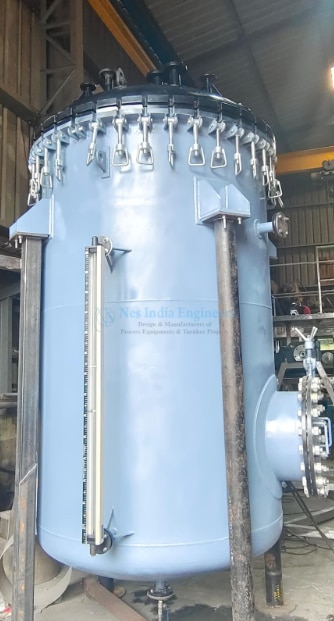
Rate the vessel for maximum reaction temperature, pressure, vacuum and credible upset conditions. Require the applicable pressure-vessel design code, vacuum-stability calculation, jacket or coil duty, and vacuum-hold test. A larger vessel will not rescue a condenser or vacuum system that cannot handle solvent vapour.
Specify the protection basis for the complete reactor process equipment package:
- Relief sizing for runaway reaction, blocked outlet, cooling failure, utility loss, decomposition, loss of agitation and two-phase discharge
- High-temperature, high-pressure, low-level and agitator-trip interlocks
- Rupture disc or relief valve discharge to a safe collection system
- Earthing, bonding and hazardous-area-rated instruments and motors
- Factory leak, pressure, vacuum, control and performance tests tied to guaranteed heat removal and discharge time
This turns a specialty chemical reactor into equipment suited to the actual recovery chemistry.
Compare the complete reactor package before choosing a manufacturer
Require a complete, duty-based package—not a vessel quotation—before choosing a process reactor manufacturer. The phrase “process reactor manufacturer for specialty chemical plants in pune” identifies a procurement location, not proof that the supplier understands your chemistry.
| Scope | Require | What it prevents |
|---|---|---|
| Pressure vessel | Material of construction, design code, pressure-vacuum rating, design temperature, surface finish, and drainability | A vessel that survives pressure but cannot handle corrosion, cleaning, or evacuation |
| Complete reactor system | Vessel, agitator, seal, condenser, receiver, vacuum system, dosing, discharge, instruments, and controls | A larger reactor being limited by vapour handling, mixing, or discharge |
| Integrated project responsibility | Process and mechanical design, relief engineering, utility integration, commissioning, and performance testing | Gaps between separate suppliers during recovery |
Ask the process reactor manufacturer to state guaranteed values at named conditions, not “high efficiency” or agitator horsepower. Require:
- Heat-removal capacity at your actual heating and cooling utility temperatures
- Mixing or blending time across the specified viscosity and solids-loading range
- Vacuum hold performance, leak rate, allowable solids loading, and discharge time
- Relief calculations covering runaway reaction, blocked outlet, cooling failure, loss of agitation, decomposition, and two-phase discharge
- Fabrication drawings, weld records, material certificates, instrument list, control logic, factory acceptance tests, installation procedure, and commissioning support
Nes India Engineers belongs in the same comparison: give it this duty sheet and require the same evidence as every other process reactor manufacturer. A quote that omits condenser capacity, utility conditions, safeguards, or performance testing is not a comparable quote.
Related product
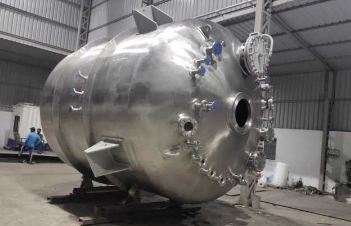 | Chemical Reactor What Is A Chemical Reactor? These devices can be used to help with the chemical reaction process. View product → |
Frequently asked questions
What should you do before attempting to recover a failed batch?
Quarantine the material, stop transfers, preserve representative samples, and open a deviation record before changing temperature, pH, solvent ratio or agitation.
How do you choose a recovery route for a failed batch?
Identify the failure mode first, then select a route that addresses the specific cause, such as incomplete reaction, crystallisation, phase separation, contamination or excessive colour.
How should you size a reactor for batch recovery?
Base the size on usable working volume, required headspace, heat removal capacity, mixing duty, feed additions and the volume created during quench or dilution.
What should you specify for a specialty chemical reactor?
Specify wetted materials, agitator geometry, seals, jacket or coil duty, temperature and pressure limits, instrumentation, venting, emergency safeguards and cleaning requirements.
How should you compare process reactor manufacturers?
Compare the complete package, including design calculations, fabrication quality, testing, controls, documentation, installation support, maintenance and lifecycle cost.