
Petrochemical reactions lose consistency when heat, reactants, gases, or catalyst particles remain unevenly distributed. By the end, you will be able to connect agitation to measurable process results, choose the right reactor mixing system, and prepare a specification that separates genuine performance from a generic tank quotation.
Key takeaways
- Use agitation to reduce hot spots and concentration gradients during reaction.
- Match impeller type and speed to viscosity, solids content, and heat-transfer needs.
- Specify design pressure, metallurgy, seals, relief protection, and cleaning requirements.
- Compare suppliers on engineering documents, testing, fabrication quality, and service support.
Where agitation changes petrochemical process results
A petrochemical reactor delivers more consistent conversion when agitation prevents hot spots, concentration gradients, and uneven residence-time exposure. In an agitated chemical reactor, circulation brings fresh reactant to the reaction zone and distributes heat through the working volume.
Agitation does not change equilibrium conversion or the rate constant; it improves results when mixing or transport limits the reaction.
1. Map the transport problem. Record viscosity, density, gas rate, solids loading, reaction heat, and the required liquid, gas–liquid, or liquid–solid contact. Poor circulation can leave catalyst settled, gas poorly dispersed, or reactant pockets that drive side reactions.
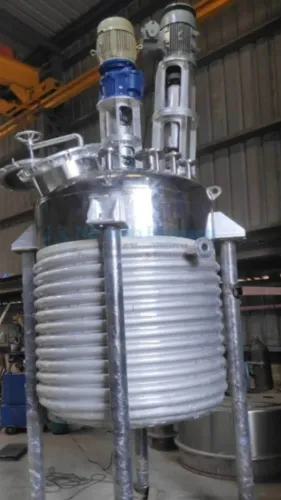
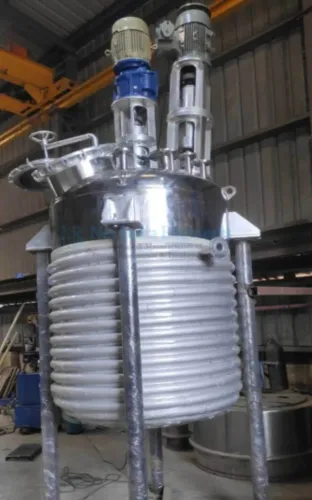
2. Check heat control at the worst case. Agitation raises the liquid-side heat-transfer coefficient, but it cannot overcome inadequate jacket area, weak coolant temperature driving force, fouling, or heat release above removal capacity. Internal coils add area but reduce working volume, obstruct solids circulation, and complicate cleaning.
3. Set a measurable acceptance test. Use tracer blending time for liquid uniformity, temperature uniformity and heat-up or cool-down rate for thermal duty, gas holdup or mass-transfer performance for gas service, and solids concentration or suspension behaviour for slurry service. Rpm and motor nameplate power alone prove nothing.
The payoff is controlled transport: reactants meet at a repeatable rate, heat reaches the jacket or coils faster, and solids remain available for reaction. Specify heat-transfer area on either clean or fouled conditions, and state which basis you require.
Which petrochemical operations suit an agitated reactor
Neutralisation, hydrogenation, polymerisation, oxidation, and esterification benefit from an agitated reactor when reaction quality depends on controlled contact between phases or uniform temperature. Catalyst slurries, gas–liquid reactions, liquid–liquid blending, and crystallisation also suit this equipment because an impeller actively circulates the contents rather than relying on diffusion.
Choose an agitated reactor for duties such as:
- Suspending solid catalysts or crystals throughout a liquid
- Dispersing hydrogen, oxygen, or another gas into a reacting liquid
- Managing viscosity changes during polymerisation or concentration
- Preventing hot spots during exothermic neutralisation or oxidation
- Maintaining consistent exposure time in batch or continuous processing
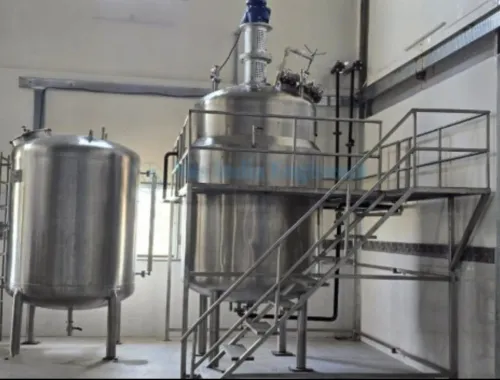
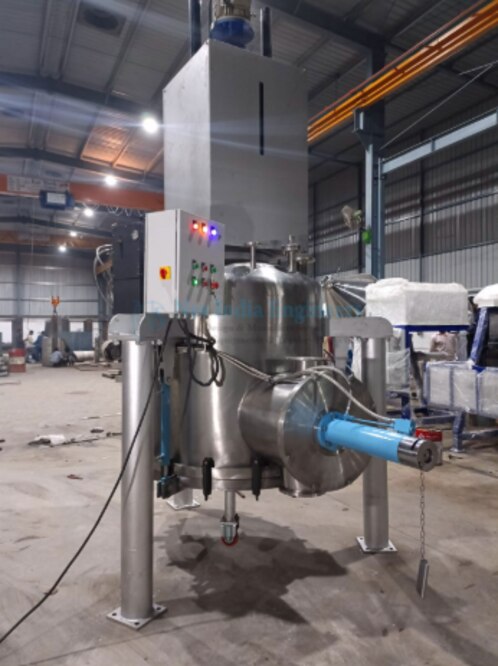
An agitated reactor manufacturer must match the vessel, impeller, baffles, shaft, seals, and drive to the process. Vessel volume alone cannot establish suitability; viscosity, gas rate, solids loading, heat duty, and pressure determine whether the contents circulate properly.
| Option | Mixing and reaction behaviour | Best fit |
|---|---|---|
| Agitated reactor | Forced circulation, heat transfer, and phase contact | Viscous, multiphase, exothermic, or solids-bearing reactions |
| Simple tank | Little bulk circulation; dead zones can develop | Storage or low-demand blending |
| Static mixer | In-line mixing without a moving shaft | Continuous, low-to-moderate-viscosity streams |
| Tubular reactor | Flow-based residence time with limited backmixing | Fast continuous reactions |
| Fixed-bed reactor | Fluid passes through an immobilised catalyst | Catalytic gas or liquid service |
| Unagitated vessel | No controlled bulk turnover | Holding, not mixing-sensitive reaction duty |
How to size the impeller, drive, and heat-transfer surfaces
Size the reactor mixing system from the hardest operating condition, not vessel volume alone. Use liquid height, viscosity, density, gas rate, solids loading, pressure, heat-removal duty, and batch changes to define the design envelope.
1. Select the impeller for the controlling duty. Use an axial-flow impeller for bulk circulation and solids suspension, a radial-flow turbine for gas dispersion, and an anchor or helical design for high-viscosity service. Polymerisation and crystallisation require checks at both initial and final viscosity.
2. Set impeller diameter from tank diameter, liquid height, and required turnover. Check pumping capacity, tip speed, Reynolds number, shear, and clearance at each scale; constant rpm is not a valid scale-up rule when these objectives conflict.
3. Choose speed from the required blending, suspension, heat-transfer, or gas-dispersion result. Check the gas rate against flooding: excessive speed can trap gas around the impeller, reduce circulation, and worsen dispersion.
4. Fit baffles when the vessel would swirl instead of circulate. Size and position them with the impeller and shaft arrangement; use multiple impellers or a longer shaft when liquid height exceeds one impeller’s effective circulation zone.
5. Calculate motor power with power number, density, speed, and impeller diameter, then verify shaft torque, startup load, seal load, and gearbox rating at maximum viscosity and solids concentration. Specify service factor from the worst case, not normal operation.
6. Size jackets and coils for fouled heat-transfer area, stating the fouling allowance. Larger area improves control but reduces working volume, obstructs solids, and adds cleaning surfaces. Acceptance testing should measure tracer uniformity, temperature rate, gas holdup, or solids suspension—not rpm alone.
How pressure, materials, seals, and safeguards protect the process
A pressure vessel that survives its design pressure can still fail its process duty if the shaft seal leaks, the jacket cannot remove reaction heat, or solids settle below the impeller.
Specify the petrochemical reactor for both pressure-boundary integrity and agitation performance; ASME BPVC Section VIII design, fabrication, inspection, testing, and records do not prove adequate mixing.
Select wetted materials from composition, temperature, pressure, corrosion rate, chloride exposure, and cleaning chemistry. Use corrosion allowance, cladding, or a liner where the process demands it.
The closure and agitator train need a pressure-rated shaft, suitable bearings, baffles, and a seal system sized for shaft speed, vapor pressure, solids, dry-running risk, toxic chemicals, and leakage detection.
- Fit a pressure-relief valve, rupture disk, or combined arrangement for runaway reaction, blocked outlet, gas expansion, and fire exposure. Route discharge to a safe flare, scrubber, or collection system.
- Use nitrogen inerting, oxygen monitoring, earthing and bonding, and an appropriately rated motor and instruments where volatile hydrocarbons or flammable gases create an ignition risk.
- Interlock high temperature, high pressure, low seal-fluid pressure, loss of cooling, and agitator overload with feed isolation and emergency shutdown.
| Hazard | Construction or safeguard | Failure prevented |
|---|---|---|
| Heat release | Jacket or coils sized for peak duty, with high-temperature trip | Runaway temperature |
| Corrosive slurry | Compatible alloy or lining and solids-tolerant seal | Wall or seal attack |
| Volatile hydrocarbon | Closed vent, inerting, relief path, hazardous-area equipment | Vapour release or ignition |
How to specify and evaluate a petrochemical reactor supplier
Reject any quotation based only on vessel volume and motor horsepower. An agitated reactor manufacturer for petrochemical processing in Pune needs the process envelope before it can size the reactor mixing system or guarantee results.
1. Issue one process data sheet to every bidder. State batch or continuous operation, composition, viscosity and density at minimum and maximum conditions, reaction heat, temperature range, operating and design pressure, gas rate, solids loading, hazardous-area classification, materials of construction, cleaning method, and required heat-up or heat-removal rate.
2. Require a mechanical proposal that identifies impeller type, diameter-to-tank ratio, liquid height, baffles, shaft arrangement, seal, motor rating, torque, and speed range. Demand torque and power checks at initial and final viscosity, not just the nameplate value.
3. Define a performance test before placing the order. Use tracer blending time and concentration uniformity for liquid service; temperature uniformity and heat-up or cool-down rate for thermal duty; gas holdup or mass-transfer performance for gas service; and solids concentration or suspension height for slurry service.
4. Separate pressure compliance from mixing performance. Request the stated code basis, design calculations, material certificates, welding procedure and welder records, non-destructive examination reports, pressure-test record, relief-device data, and inspection dossier. ASME BPVC Section VIII applies when specified by the contract or governing authority.
5. Put measurable acceptance limits in the purchase order: maximum blending time, allowable temperature deviation, achieved heat-transfer rate, suspension criterion, leakage limit, vibration, and sound level. Ask Nes India Engineers to quote against those same limits, not a generic chemical reactor description.
Related products
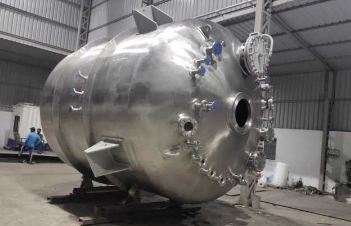 | Chemical Reactor What Is A Chemical Reactor? These devices can be used to help with the chemical reaction process. View product → |
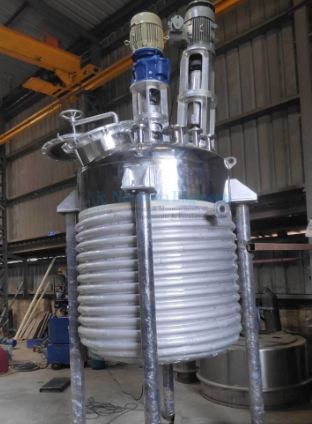 | Mixing Vessel Nes India Engineers are the most leading Manufacturers, Suppliers, Exporters of Mixing Vessel in India, Pune, Aurangabad, Goa, Chennai, Mumbai,... View product → |
Frequently asked questions
Where does agitation improve petrochemical process results?
Agitation improves circulation, distributes heat, reduces concentration gradients, and exposes reactants to more consistent residence conditions.
Which petrochemical operations suit an agitated reactor?
Agitated reactors suit liquid-phase reactions, gas-liquid reactions, slurry processing, heat-sensitive reactions, and processes requiring controlled temperature or composition.
How do you size an impeller, drive, and heat-transfer surface?
Base selection on viscosity, density, flow behaviour, solids loading, batch volume, mixing time, heat duty, pressure, and allowable tip speed.
What safeguards protect a petrochemical reactor?
Use materials compatible with the chemistry, pressure-rated construction, suitable mechanical seals, temperature and pressure controls, relief devices, and interlocks.
How should you evaluate an agitated reactor manufacturer?
Review process calculations, drawings, material certificates, weld and inspection records, pressure testing, mixing validation, commissioning support, and after-sales service.