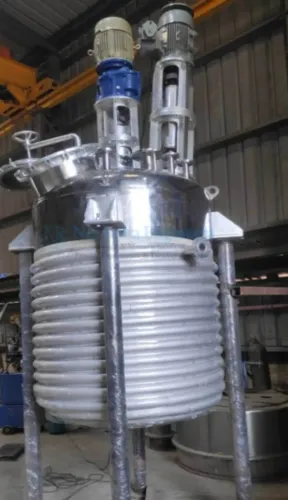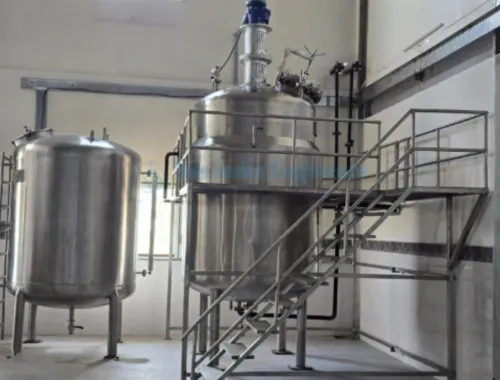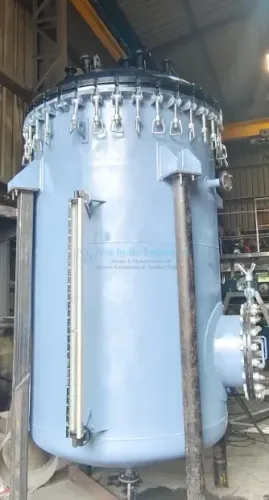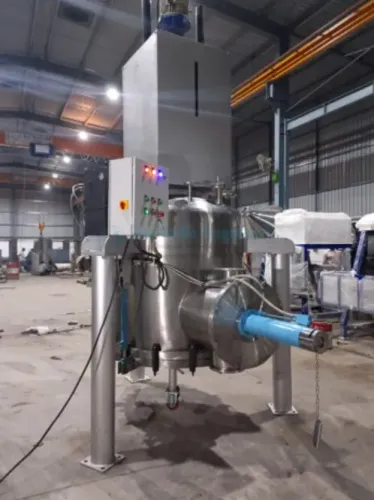

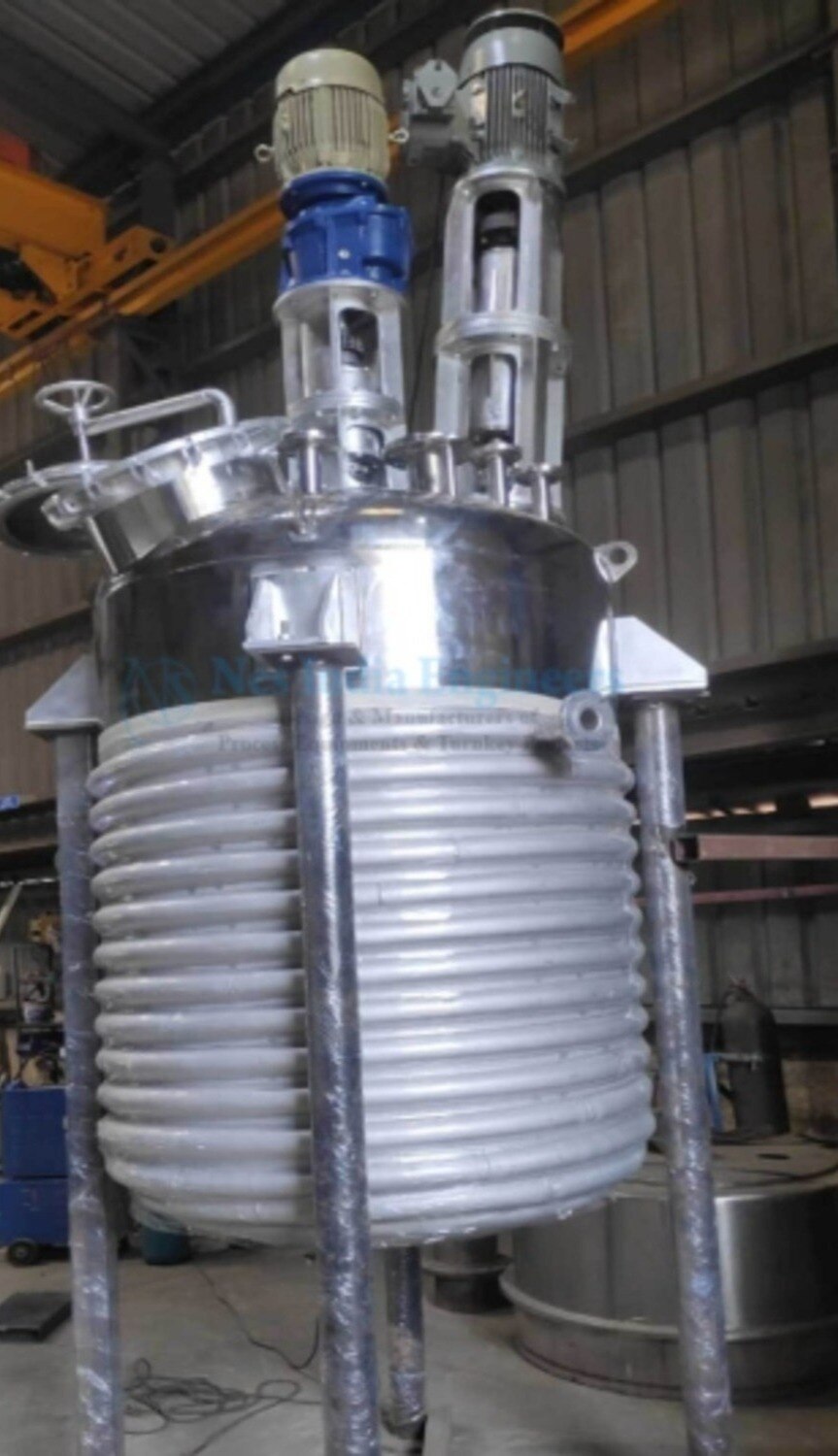
A batch can meet its average assay target while the top, middle, bottom, and outlet zones still contain different concentrations, temperatures, or suspended-solid levels. By the end, you will be able to connect product properties and batch volume to tank geometry, agitator selection, powder addition, sampling, cleaning, and validation evidence.
Key takeaways
- Define uniformity by composition, temperature, pH, solids, and physical properties.
- Match impeller type, tank geometry, and speed to viscosity and solids content.
- Control powder addition, vortexing, settling, and outlet turnover during each batch.
- Validate mixing time, sampling locations, cleaning results, and equipment documentation.
What uniformity means across a pharmaceutical batch
A pharmaceutical mixing tank is uniform only when every representative zone meets the predefined quality criteria, not merely when the agitator turns. Uniform pharmaceutical mixing must control composition, temperature, pH, suspended solids, and physical properties throughout the top, middle, bottom, wall, centre, and outlet regions.
| Quality attribute | What uniformity means | How to detect a gradient |
|---|---|---|
| Blend uniformity | Each portion contains the intended proportion of ingredients | Assay samples from top, middle, bottom, and discharge points |
| Concentration and content uniformity | Active ingredient or dissolved solid stays within the approved range | Use a validated assay on timed, location-specific samples |
| Temperature uniformity | No zone falls outside the processing temperature range | Map temperatures with probes during heating, cooling, and hold periods |
| pH uniformity | Samples show the same pH within the acceptance criterion | Measure samples from different vessel heights and after circulation |
| Suspension uniformity | Solids remain evenly distributed without settling or flotation | Test solids concentration at the surface, centre, bottom, and outlet |
| Viscosity or particle-size uniformity | The batch retains the required flow and particle characteristics | Compare samples after mixing and at defined hold times |
Write the sampling plan before qualification. Include sample locations, sampling times, sample volume, container handling, validated analytical methods, and pre-established acceptance criteria; 21 CFR 211.110 identifies adequacy of mixing, dissolution, and homogeneity as in-process controls supporting batch uniformity.
Treat heat mapping as a separate study from composition testing. A jacket can deliver the correct average temperature while cold or concentrated pockets remain near the wall, bottom, or outlet. A failed location or time point identifies a circulation problem that motor speed alone cannot prove.
Match the agitator and tank geometry to the process
Choose the agitator from viscosity, solids loading, density, gas sensitivity, temperature, and the required flow pattern—not from motor speed alone. In a batch mixing vessel, match the impeller to the process:
| Agitator | Best fit | Main caution |
|---|---|---|
| Anchor | High-viscosity creams, gels, and laminar batches; sweeps the wall | Slow bulk circulation; add scrapers for heat-transfer surfaces |
| Paddle | Gentle blending of low- to medium-viscosity liquids | Poor top-to-bottom turnover in tall tanks |
| Pitched-blade turbine | Axial circulation, moderate viscosity, and suspended solids | Excessive speed can create vortexing and foam |
| Hydrofoil | Efficient low-shear blending and suspension at lower power | Needs suitable clearance and baffles to prevent bulk swirling |
| Rotor-stator | Rapid dispersion, deagglomeration, and localized emulsification | Generates heat and shear; it does not replace whole-vessel circulation |
| High-shear mixer | Powder wetting, emulsification, and particle-size reduction | Can damage shear-sensitive materials and entrain air |
Use a taller tank when vertical turnover matters, but confirm that the impeller reaches every zone. A rounded or dished bottom reduces corners where solids settle; a flat bottom needs low clearance or a sweeping anchor.
Specify baffle width, number, and wall clearance rather than copying another tank. Baffles suppress swirling, yet poorly positioned ones create stagnant pockets and complicate cleaning. Impeller diameter and bottom clearance determine whether the outlet zone turns over.
Qualify minimum, nominal, and maximum liquid levels. A low fill can expose an impeller, weaken axial circulation, increase vortexing, and pull air into the product. Higher viscosity or solids loading can change the flow regime at the same speed.
Control powder addition, settling, vortexing, and outlet turnover
A pharmaceutical mixing tank should qualify powder charging at minimum, nominal, and maximum fill volumes. Running below design level can expose the impeller, weaken axial turnover, and pull air into the batch. Keep the impeller submerged, use baffles to control surface rotation, and reduce speed before a vortex reaches the impeller.
Set the charging and circulation controls around the product’s viscosity, density, solids loading, and foaming tendency:
- Feed powder below the liquid surface into the strongest circulation zone; meter it slowly enough for wetting to keep pace with addition.
- Pre-wet difficult powders as a validated slurry, or use an induction device, when dry addition produces floating powder or persistent lumps.
- Maintain bottom-directed flow and adequate impeller clearance to resuspend settled solids; do not rely on higher speed if it creates foam or damages particles.
- Keep return lines submerged and remove leaks on the suction side, since both conditions introduce air and increase entrainment.
- Reduce speed or feed rate when a stable foam layer forms; allow headspace for foam without changing the working volume unexpectedly.
Prevent stratification by proving circulation through the top, middle, bottom, and outlet zones at each qualified batch volume. Place the withdrawal point where the bulk is mixed, and size recirculation flow to prevent short-circuiting from return to outlet.
Hold discharge until samples meet the written assay or concentration criterion, as required by the batch-control approach in 21 CFR 211.110.
Prove mixing time, sampling reliability, and cleaning performance
A qualified batch mixing vessel earns its mixing time from data: every planned sample location and time point must meet the assay or concentration criterion, not merely show a stable motor load.
1. Define the operating window before the trial. Record fill volume, powder addition rate, order of addition, agitator speed, temperature, viscosity, and batch size. Link these critical process parameters to critical quality attributes such as assay uniformity, viscosity, particle-size distribution, dissolution, pH, or suspension stability.
2. Run the trial at the hardest-to-mix condition, then sample the top, middle, bottom, recirculation line, and outlet. Take samples before mixing, during the expected blend period, and after the proposed endpoint. Use a validated analytical method, documented sample mass and location, and a handling procedure that prevents settling or segregation inside the sample container.
3. Set the endpoint in advance. Accept uniform pharmaceutical mixing only when every representative sample meets the approved assay or concentration range, with the required number of consecutive time points passing. A high-speed agitator does not compensate for a poor sample plan.
4. Map temperature separately from composition. Place probes in jacket-adjacent, centre, upper, lower, and outlet zones, and confirm heating or cooling does not create local gradients.
5. Challenge cleaning with the installed spray device and worst-case product. Verify coverage, flow velocity, temperature, chemical concentration, contact time, drainability, and difficult locations using riboflavin coverage testing plus validated swab or rinse limits. A spray ball alone proves nothing; document the repeatable cleaning cycle and confirm it during continued process verification.
Specify and evaluate a manufacturer for GMP-ready equipment
Require a mixing tank manufacturer to submit a design against your User Requirements Specification, not a quotation based only on nominal capacity. A mixing tank manufacturer for pharmaceutical plants in Pune must address the same GMP, hygienic-design, utility, and validation requirements as a supplier in any regulated market.
Give every bidder the same viscosity, density, solids loading, temperature range, batch-size limits, fill levels, mixing-time target, cleaning method, and allowable shear. Require scale-up evidence showing how impeller diameter, speed, power per volume, circulation, heat-transfer area, and sampling results change from pilot to production scale.
A larger vessel is not compliant simply because its working volume matches the batch.
Use this checklist when comparing proposals:
- Require 316L material certificates, elastomer certificates, weld maps, weld-inspection records, internal surface-finish readings, passivation records, and ASME BPE design details where specified.
- Require general-arrangement, fabrication, nozzle, agitator, seal, drain, instrumentation, and utility drawings.
- Require calibration certificates and instrument ranges for temperature, pressure, load, pH, or other process sensors.
- Require FAT protocols and results covering leak testing, rotation, alarms, controls, drainability, and documented mixing trials.
- Require SAT support, commissioning records, and IQ/OQ documentation or traceable input for your validation package.
- Reject designs with crevices, unsealed shafts, non-drainable valve cavities, poorly sloped piping, or inaccessible welds.
Whether the bidder is Nes India Engineers or another supplier, keep the same approval gates and change-control records through installation and qualification. q
Related product
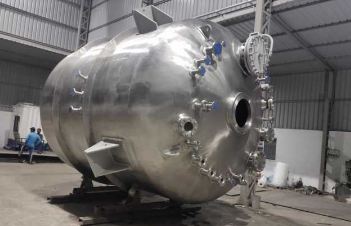 | Chemical Reactor What Is A Chemical Reactor? These devices can be used to help with the chemical reaction process. View product → |
Frequently asked questions
What does uniformity mean in a pharmaceutical batch?
Uniformity means representative zones meet predefined limits for composition, temperature, pH, suspended solids, and physical properties across the tank and outlet.
How do you choose an agitator for a pharmaceutical mixing tank?
Choose the impeller and tank geometry from viscosity, solids loading, liquid depth, heat-transfer needs, shear sensitivity, and the required circulation pattern.
How can operators prevent powder settling and vortexing?
Control powder feed rate and location, agitator speed, liquid level, baffles, and addition sequence; verify that solids remain suspended without drawing air into the batch.
How do you prove a batch mixing vessel performs consistently?
Run mixing-time studies, sample top, middle, bottom, wall, centre, and outlet zones, and document cleaning performance with defined acceptance criteria.